REVIEW · Concerts & Live
MAKOTO. places her own song among familiar classics — Kabukicho Street Live
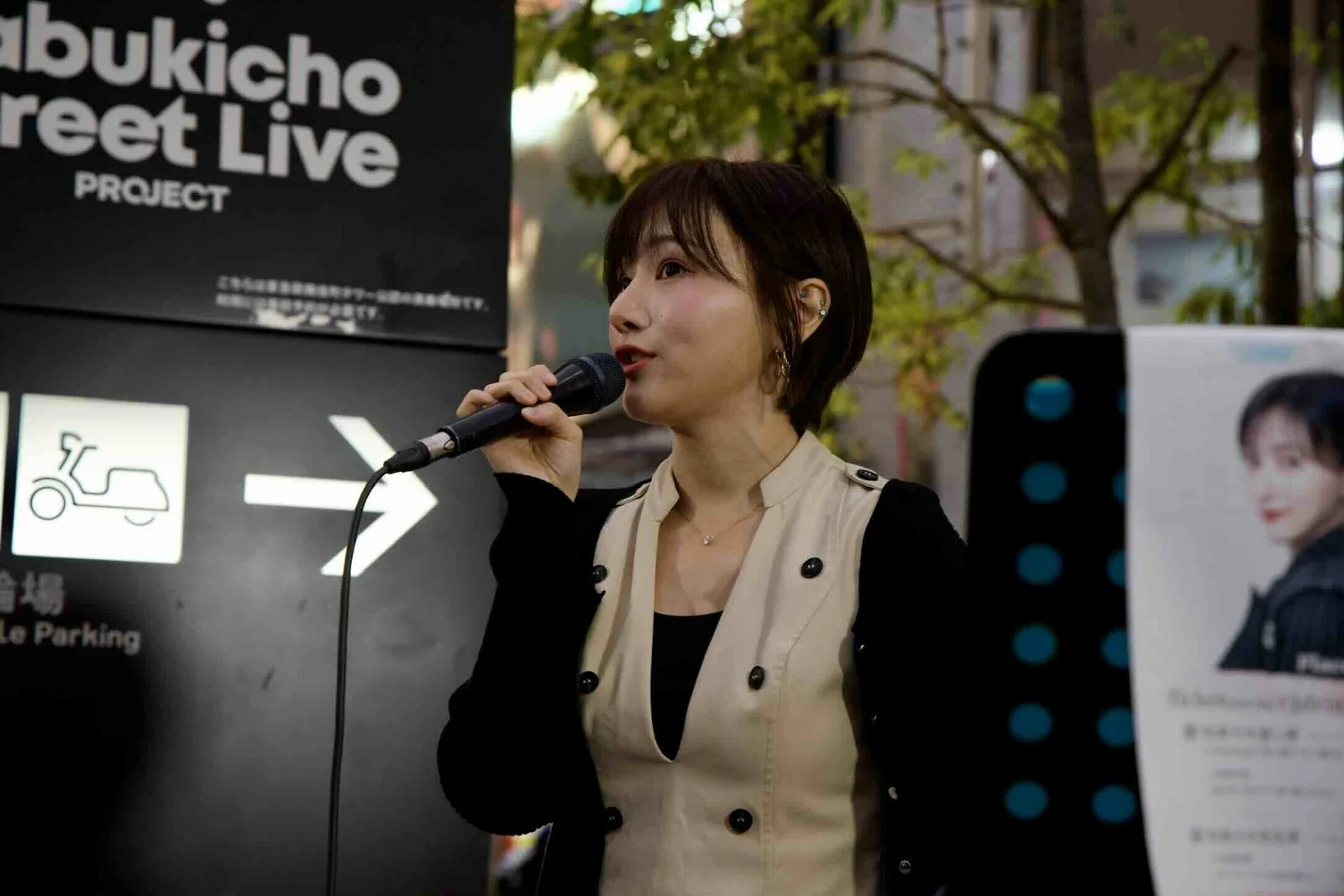
At 6 p.m. on September 5, 2026, MAKOTO. gave a street performance outside Wagyu Tokku on the first floor of Tokyu Kabukicho Tower in Shinjuku, Tokyo. The show was part of Kabukicho Street Live, an authorized street-performance program operating in the area. Held in an open space in the heart of the city rather than a dedicated concert hall, it allowed fans who already knew the artist and ordinary visitors passing through Kabukicho to encounter music in the same place.
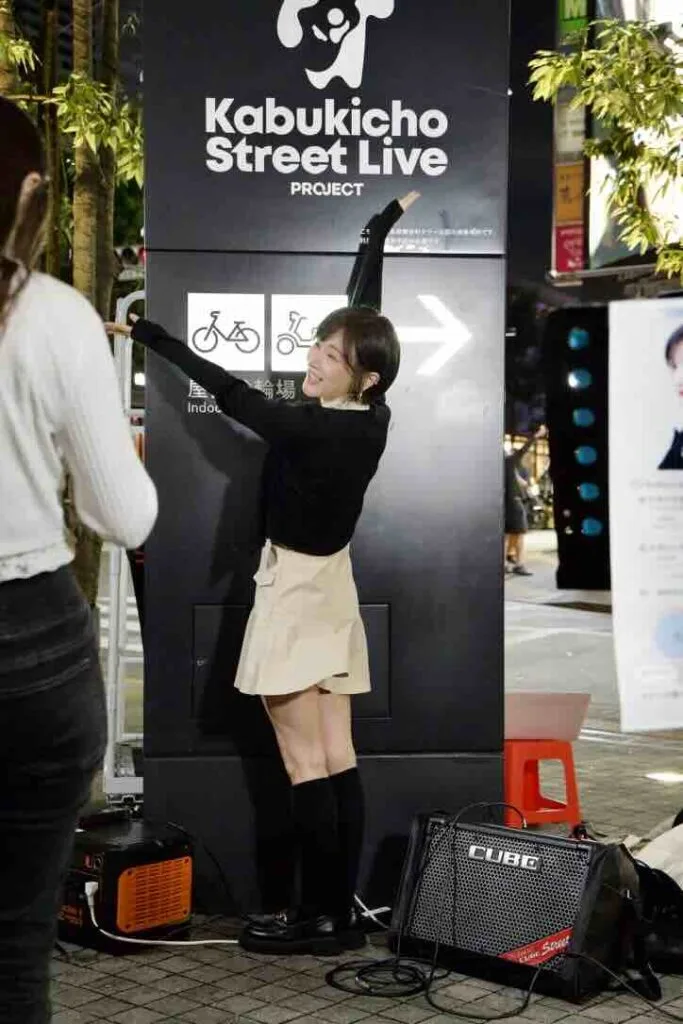
Centered on Tokyu Kabukicho Tower, Kabukicho Street Live officially opens a stage to artists wishing to perform on the street. The space outside Wagyu Tokku currently operates by reservation, and the organizers use the area as a place where emerging artists can present their music and meet new audiences. Unlike a closed venue such as a live music club admitting only ticket holders, it lets the city’s passing crowds mingle naturally with existing fans. For singers still working to make their names more widely known, such a stage offers another kind of opportunity.
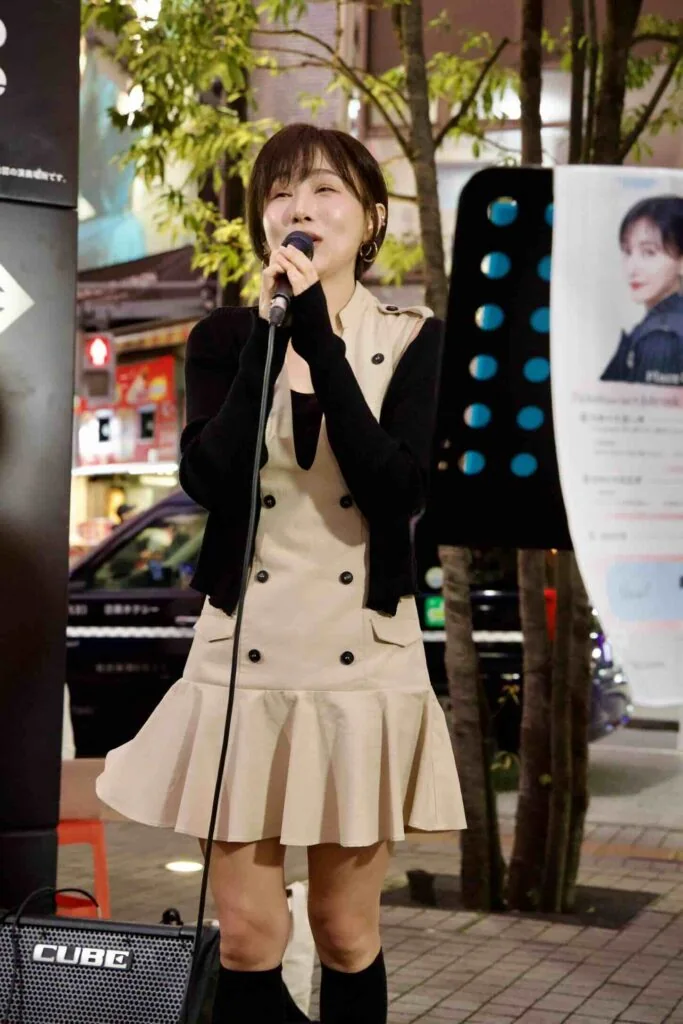
MAKOTO. took that space under her own name, leading a performance of about an hour rather than sharing the stage with several others. She is a familiar face through sis, but audiences inevitably see something different when she sings as a group member and when she alone is responsible for a street show from beginning to end. This performance offered a chance to observe precisely that difference.
From city pop to ballads: familiar songs as an entry point
The show opened with Yasuha’s “Flyday Chinatown,” followed by Toshinobu Kubota’s “LA・LA・LA LOVE SONG” and Mariya Takeuchi’s “Plastic Love.” These songs are familiar to longtime listeners of Japanese popular music, and the recent international rediscovery of Japanese city pop has also brought them to younger generations.
The opening three selections suited the street-performance setting. At a solo concert, a setlist can assume that most of the audience already knows the singer; on the street, circumstances differ. Alongside fans who have come specifically for the show, people who happen to hear a song and stop are potential listeners. In this setting, a familiar melody can be the quickest way to draw attention to the voice of a singer someone has never seen before.
The Checkers’ “Julia ni Heartbreak” (ジュリアに傷心) then broadened the show’s range of eras and genres. Rather than concentrating on city pop as a single trend, the selection connected Japanese popular songs with different colors through MAKOTO.’s voice. Including Southern All Stars’ “Manatsu no Kajitsu” (真夏の果実), chosen later in the set, the performance was less a recreation of one genre than a reconnection of familiar Japanese music from different periods through one vocalist, MAKOTO.
MAKOTO. SETLIST
MAKOTO. Kabukicho setlist
Performance order
- 「Flyday Chinatown」
- 「LA・LA・LA LOVE SONG」▶ Watch video
- 「Plastic Love」▶ Watch video
- “Julia ni Heartbreak” (ジュリアに傷心)▶ Watch video
- “Kono Melody ga Owaru made” (このメロディーが終わるまで)▶ Watch video
- “Manatsu no Kajitsu” (真夏の果実)▶ Watch video
- “Kono Melody ga Owaru made” (このメロディーが終わるまで) — Encore▶ Watch video
Her own song among the covers
The fifth song, however, made it difficult to describe the show simply as a set of Japanese classics. After a sequence of songs already known across generations, MAKOTO. sang her original, “Kono Melody ga Owaru made” (このメロディーが終わるまで).
Famous covers are powerful tools in street performances. They can readily stop someone who has never seen the performer, quickly introducing a singer’s voice through melodies the listener already knows. But if a show ends with covers alone, the memory left behind may be limited to “a singer who performed familiar songs well.” What matters, ultimately, is how that interest moves from the covers to the artist’s own music.
In that respect, the placement of “Kono Melody ga Owaru made” was interesting. Instead of leading with her own material, she first gave listeners ample time with her voice through “Flyday Chinatown,” “LA・LA・LA LOVE SONG,” “Plastic Love” and “Julia ni Heartbreak.” Only then did she introduce her own song. Familiar music established a connection before the set answered the question: what is this singer’s own music?
“Manatsu no Kajitsu” returned the show to the cover repertoire. One of Southern All Stars’ signature ballads, it created an emotional line different from the relatively rhythmic songs that preceded it and closed the planned six-song set. The performance could have ended there as a fairly typical street show of five covers and one original. On this day, however, one more song remained.
An unexpected encore: “Kono Melody ga Owaru made” again
The performance did not end immediately after the six prepared songs. Time became available for one additional number, and calls for an encore naturally arose from the audience. MAKOTO.’s final choice was “Kono Melody ga Owaru made,” which she had already sung once.
The set’s only original was therefore performed twice. She could have chosen another famous cover, but returning to her own song at the last moment changed the impression of the entire show. A performance that began with “Flyday Chinatown” and traveled through different eras of Japanese popular music ultimately ended with MAKOTO.’s own song.
Singing the same song twice in one show would be somewhat unusual at a standard solo concert. As an impromptu encore added after a street show’s planned set, however, it felt natural. Above all, giving those who had watched from the start another hearing of “Kono Melody ga Owaru made” made clear which song she wanted them to associate with her name after this performance.
If the covers stopped people in their tracks, the final original left the singer’s own name with those listeners. The two functions need not compete in a street performance. Attracting people with well-known music and giving them a reason to return through an original song is, rather, the most practical structure.
MAKOTO. of sis and MAKOTO. the solo singer
Another interesting aspect of this performance was the change in how MAKOTO. was viewed. In an sis show, several members share different voices and personalities to create one stage. One member takes the center in a song, and another draws the audience’s attention at a different moment. The pleasure of a group performance grows from those relationships and shifts.
That structure disappears in a solo street show. One person must carry each song from beginning to end and maintain both the flow between songs and the audience’s concentration. Without elaborate stage equipment or a large band, the singer’s voice and choice of repertoire are exposed more directly. In that sense, this was an opportunity to encounter an individual vocalist differently from the MAKOTO. seen in sis.
In particular, keeping her original as the central axis of a cover-led show connects with the process of developing her identity as a solo singer. Good covers alone can gather a crowd on the street. But continued activity under her own name ultimately requires her own songs—music audiences will seek out again. The two appearances of “Kono Melody ga Owaru made” pointed in that direction even within an original repertoire that is still small.
How Kabukicho opens a stage to street singers
The venue also mattered to the meaning of the performance. Kabukicho Street Live is not simply busking in which a singer finds an empty space and starts singing. It is an authorized program through which Tokyu Kabukicho Tower and local operators formally provide space. The area outside Wagyu Tokku can be reserved, with performances and merchandise sales taking place under official operating rules.
This structure preserves the chance encounters of street performance while giving artists a minimally stable space to present their work. For fans who come to see the artist, it is an official engagement with a fixed time and place. For someone walking through Kabukicho, it is a free show encountered unexpectedly. A performance for existing fans and a showcase seeking new listeners overlap in the same space.
Kabukicho’s character reinforces this arrangement. When small live shows continue on streets crowded with major venues, live music clubs, cinemas, restaurants and entertainment facilities, music no longer stays inside particular buildings. It reaches ordinary visitors using the city as well as those who bought tickets for a performance. That openness also helps explain why the organizers define Kabukicho Street Live as a place to discover and nurture new talent.
The name to remember after the familiar songs end
The power of covers in street performance is clear. Songs such as “Flyday Chinatown” and “Plastic Love,” recognizable from their opening lines, can stop passersby. “LA・LA・LA LOVE SONG” and “Manatsu no Kajitsu” also have melodies remembered across generations. In a street setting, that familiarity is itself one of the strongest promotional tools.
Yet the ultimate purpose of a show cannot be merely to publicize the covered songs again. A street performance gains practical meaning for an artist when someone who stopped to listen begins wondering who sang the song, then looks up the singer’s name or original music after the show.
MAKOTO.’s September 5 set illustrated that simple principle fairly clearly. Starting with well-known Japanese popular music, she passed through songs from different eras in her own voice before returning, at the end, to her own “Kono Melody ga Owaru made.” The unexpected encore effectively completed the structure of the performance.
On the street, a familiar song can stop a person. Once that person leaves, however, what they ultimately need to remember is the name of the singer who performed it. On an evening in Kabukicho, MAKOTO. drew on the strength of already well-known songs while leaving the final number under her own name.
References
Related event footage
Related event footage from Diego’s channel.
View all videos · 6

KANO MIYU and SIS at the crossroads of Kuro Fes 2026

sis in Atami, Part 2: Evening Falls on the Same Stage

sis in Atami, Part 1: Thirty Minutes Between the Sea and Summer Light

sis Connects Two Languages at Meguriai Thank-You Concert vol.10

sis PROLOGUE: Opening a First Chapter in Seoul with Original Songs