REVIEW · Festivals
sis in Atami, Part 2: Evening Falls on the Same Stage

sis Part 2 setlist
Performance order
- “Megumi no Hito”▶ Watch video
- “Michishirube”▶ Watch video
- “GOLDFINGER ’99”
- “DIVER”▶ Watch video
- “Ai no Battery”▶ Watch video
- “Sekaijuu no Dare Yori Kitto”▶ Watch video
At 6:40 p.m. on August 24, 2026, sis’s second performance began at Shinsui Park Event Plaza in Atami, Shizuoka Prefecture, Japan. Participating in an outdoor live program ahead of the evening’s Atami Sea Fireworks Festival, the group returned to the stage roughly two hours after its 4:25 p.m. first set. Although both performances took place at the same venue on the same day, the park’s scenery had already changed considerably by the second. The strong afternoon sun had gone, evening was settling over the coast, and stage lighting was beginning to illuminate the members in earnest. People heading to the park for the fireworks continued to arrive, filling the surrounding area with a denser audience than during the daytime show.
Where Part 1 had used Atami’s blue sea and intense summer light as its backdrop, artificial stage lighting shaped the image of Part 2. Despite the stage being identical to that of a few hours earlier, even the way light fell on the members’ faces, costumes and movements had changed. In an outdoor performance, time is more than a number setting the start: it changes the visual character of the stage itself. These two shows, offering both daytime and evening experiences, made the difference particularly clear. Where natural light and the sea formed the background in Part 1, a darkening sky and stage lights assumed that role in Part 2.
Not the same six songs
Part 2 comprised six songs: “Megumi no Hito,” “Michishirube,” “GOLDFINGER ’99,” “DIVER,” “Ai no Battery” and “Sekaijuu no Dare Yori Kitto.” Four—“Megumi no Hito,” “Michishirube,” “DIVER” and “Ai no Battery”—had also appeared in Part 1. Although four of the six overlapped, their order changed, while “GOLDFINGER ’99” and “Sekaijuu no Dare Yori Kitto” replaced “Aoi Sangoshou” and “DING DONG Kudasai.”
This degree of change is a practical choice for two performances in a day and a way to give them distinct characters. Replacing everything creates a burden resembling the preparation of two separate concerts. Retaining part of a set while changing its opening, ending and key middle songs can preserve its polish while offering a different experience to those attending both. sis chose precisely that approach. Keeping the same four songs as a framework, the group moved “Megumi no Hito” from the close of Part 1 to the start of Part 2, changing the point of departure itself.
In Part 1, “Megumi no Hito” concluded the six songs, lifting the festival energy to the very end. Moved to the beginning of Part 2, it became an opening number that quickly energized the audience. A song’s function changes with its place in a setlist. What had been a song for enjoying things to the last in Part 1 became a signal that things were starting again in Part 2.
“Michishirube” followed, taking the performance back into familiar sis repertoire. It had already been heard once that day, but the changed environment altered its visual impression. In bright natural light, the members and sea could be seen as a single landscape; on the evening stage, lighting distinguished each member more clearly. This is why repeated songs need not be a weakness when seeing the same artist twice in one day. Unlike a recording, a live performance does not repeat sound alone: time, place and audience responses change with it.
“GOLDFINGER ’99”: a familiar melody becoming a different song
The freshest moment in Part 2 was the third song. Its introduction recalled Ricky Martin’s worldwide hit “Livin’ la Vida Loca,” familiar to many Korean listeners too. Once the singing began, however, the lyrics were entirely different from the English original. sis was not simply covering Martin’s recording, but performing “GOLDFINGER ’99,” the Japanese-language version released by Hiromi Go in 1999 that became a major hit in Japan.
The chorus phrase represented by “A-chi-chi, a-chi” is particularly familiar to Japanese audiences. Combining the original’s forceful Latin-pop rhythm and melody with Japanese lyrics and Go’s distinctive performance style, the song acquired a strong public memory in Japan separate from the original. Korean and Japanese listeners knowing the same melody but remembering entirely different words created an interesting moment at the show. Japanese spectators responded readily to the familiar chorus, whereas Korean spectators who knew only the original might have heard it as a song they both knew and did not know.
Beyond an amusing cultural difference, this scene shows how popular music travels across borders. When a song reaches another country, is adapted, becomes a hit again through a local singer and settles into another generation’s memory, the same melody carries different cultural experiences in each country. Just as adaptations of overseas songs have formed an important part of Korean popular-music history, Japan also offers many examples in which the local version remains a more immediate memory than the original. “GOLDFINGER ’99” is one representative example of that adaptation culture continuing into the late 1990s.
The choice also suited Atami’s summer-festival setting. The original already has a strong rhythm and an immediately engaging chorus, while the Japanese version offers clear points for audience participation. It is effective repertoire for an outdoor event enjoyed through movement and vocal responses rather than quiet listening. The members moved brightly around the stage with the song’s fast energy, and its absence from Part 1 made it the second show’s clearest distinguishing feature.
Korean and Japanese songs crossing within one set
“GOLDFINGER ’99” was followed by “DIVER” and “Ai no Battery.” “DIVER” was familiar sis repertoire also performed in Part 1, and “Ai no Battery” likewise appeared in both shows. Its inclusion in both parts, in particular, indicates the place it holds in sis’s present performances. A song known in Korea as one of Hong Jin-young’s signature numbers has become naturally recurring repertoire at regional Japanese festivals, connecting with the group’s work across both countries.
Recent sis shows often mix Korean and Japanese music naturally within one set rather than separating them strictly. There are songs familiar to Japanese audiences, such as “Megumi no Hito” and “GOLDFINGER ’99”; Korea’s “Ai no Battery” appears among them, alongside “Michishirube” and “DIVER,” which the group currently presents under its own name. The songs differ in era, country and genre, but those boundaries disappear more naturally than expected in performance.
This is both a present characteristic of sis and a direction it can develop further. For artists working across Korea and Japan, the important task is not simply alternating one Korean song with one Japanese song, but connecting repertoire from different cultures into a single performance language. “Ai no Battery” entering a Japanese set naturally, rather than being separated into a special Korean-song segment, can be seen as a small example of that change.

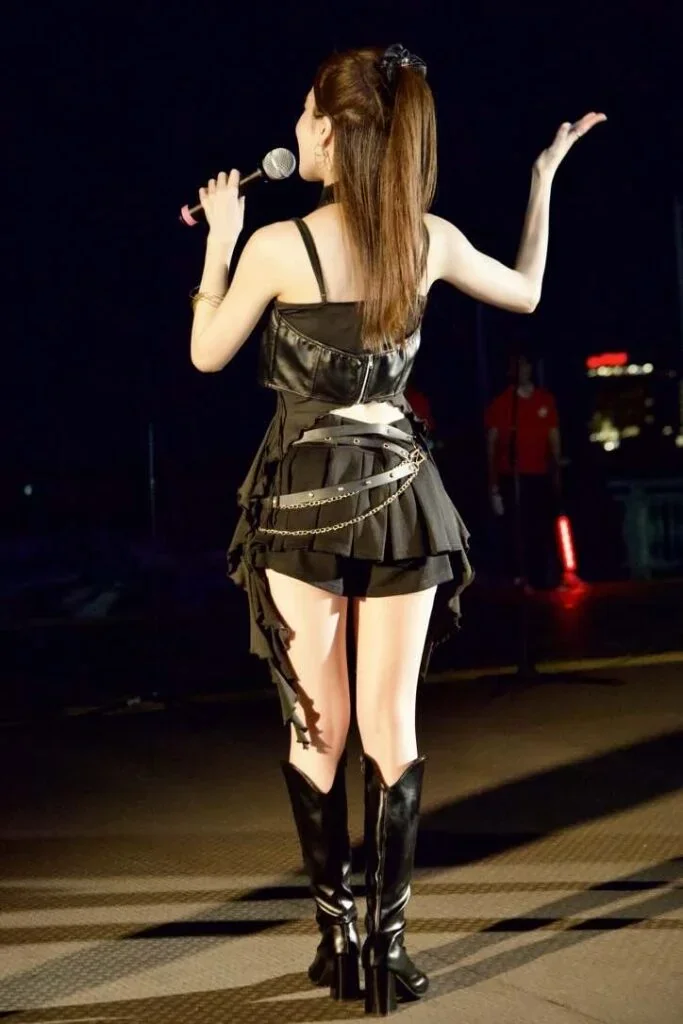
The closing choice after sunset: “Sekaijuu no Dare Yori Kitto”
Part 2 ended with “Sekaijuu no Dare Yori Kitto.” Released by Miho Nakayama and WANDS in 1992, it differs in character from a song that vigorously shakes up the audience like the earlier “GOLDFINGER ’99.” It has a bright, clear melody but also a lyricism somehow suited to evening, making it a natural choice to close the day’s two performances.
The song was especially effective when heard in relation to the time of day. Where “Megumi no Hito” had energetically concluded Part 1’s outdoor festival in the still-bright afternoon, “Sekaijuu no Dare Yori Kitto” absorbed the atmosphere of Shinsui Park after sunset and brought Part 2 to a gentler close. Choosing different final songs gave the two shows on the same stage that day endings suited to their respective hours.
Such differences matter more than one might expect in structuring two daily performances. Had the setlists been identical, the shift from natural light to stage lighting would have created sufficient visual contrast, but the memories of the performances themselves might have overlapped considerably. Part 1 began with “DING DONG Kudasai.” and ended with “Megumi no Hito”; in Part 2, that very “Megumi no Hito” became the starting point, before “Sekaijuu no Dare Yori Kitto” created a new final scene. Those watching both in succession could also enjoy the sense of the first ending leading into the second beginning.
Daytime sis and evening sis: when one stage becomes a different performance
Seen together, the most interesting feature of the two Atami shows was the balance of repetition and change. Each contained six songs, four shared. Numerically, much overlapped. Yet the changed order, two replacement songs and, above all, the substantial transformation of the surrounding environment made the experience of the stage different.
Summer in Atami stood at the center of Part 1. “Aoi Sangoshou” rang out against strong sunlight and the blue sea, while natural light revealed the members’ expressions and movements directly. In Part 2, stage lighting became more prominent as the sun went down, and people waiting for the fireworks kept gathering around the park. As the same stage shifted within a few hours from an afternoon tourist landscape to a summer-night festival space, sis’s performance acquired a different image too.
The new addition “GOLDFINGER ’99” made Part 2’s character even clearer. At the venue, it let listeners experience how the melody of a worldwide pop hit familiar to Koreans carries entirely different words and memories in Japan. Korea’s “Ai no Battery” followed, while “Sekaijuu no Dare Yori Kitto,” a representative song of 1990s Japanese popular music, occupied the ending. The seamless succession of songs from different countries and eras also made Part 2 an opportunity to confirm the breadth of sis’s present repertoire.
Outdoor performances contain many elements artists cannot control. Sunlight disappears, the surrounding audience grows, and sea colors and sky brightness keep changing. But those very changes sometimes create moments when singing the same song again in the same place looks like an entirely different show. sis’s second appearance at Shinsui Park was such a case. A small stage that had stood in summer sunlight only hours earlier became a lighted performance venue in the evening. Within that change, sis retained some familiar repertoire while completing its second thirty minutes with new songs and a different order.
Viewing the two performances as one continuous flow makes a simple comparison of which was better seem unnecessary. The afternoon scene of “Aoi Sangoshou” beside the actual sea was possible only in Part 1; the strong response to “GOLDFINGER ’99” and the ending of “Sekaijuu no Dare Yori Kitto” in the evening air belonged only to Part 2. Within a single day, the shows demonstrated in succession how different a face the same stage can assume through the passage of time alone.
The Atami Sea Fireworks Festival was scheduled to begin along the same coast at 8:15 p.m. Crowds were gathering by the water to watch it, but a little earlier, another summer scene spanning day and evening had already been completed on Shinsui Park’s small outdoor stage. sis’s first thirty minutes began at 4:25 p.m.; its second began again at 6:40 p.m. Sharing some of their setlist while varying light, air, selections and order, the two performances in the same place left distinct memories.
The same stage does not necessarily make the same performance. sis’s second Atami set demonstrated that simple fact with particular clarity.
Read the two Atami performances together
Part 1 and Part 2 shared four of their respective six songs. Changes in order and light created a different flow even for the same songs. The move of “Megumi no Hito” from the first show’s finale to the second show’s opening offers a clue to understanding the difference.
Related sources
Related event footage
Related event footage from Diego’s channel.
View all videos · 7

KANO MIYU changes the mood from afternoon to evening — Hanno Music Festival 2026

KANO MIYU returns to Fukuoka through song — Daikoku Festival 2026

KANO MIYU and SIS at the crossroads of Kuro Fes 2026

MAKOTO. places her own song among familiar classics — Kabukicho Street Live

sis in Atami, Part 1: Thirty Minutes Between the Sea and Summer Light