REVIEW · Fan Meetings & Signings
RIE UTAGOKORO’s first essay collection: a book signing for “I’ll Always Sing of Love”
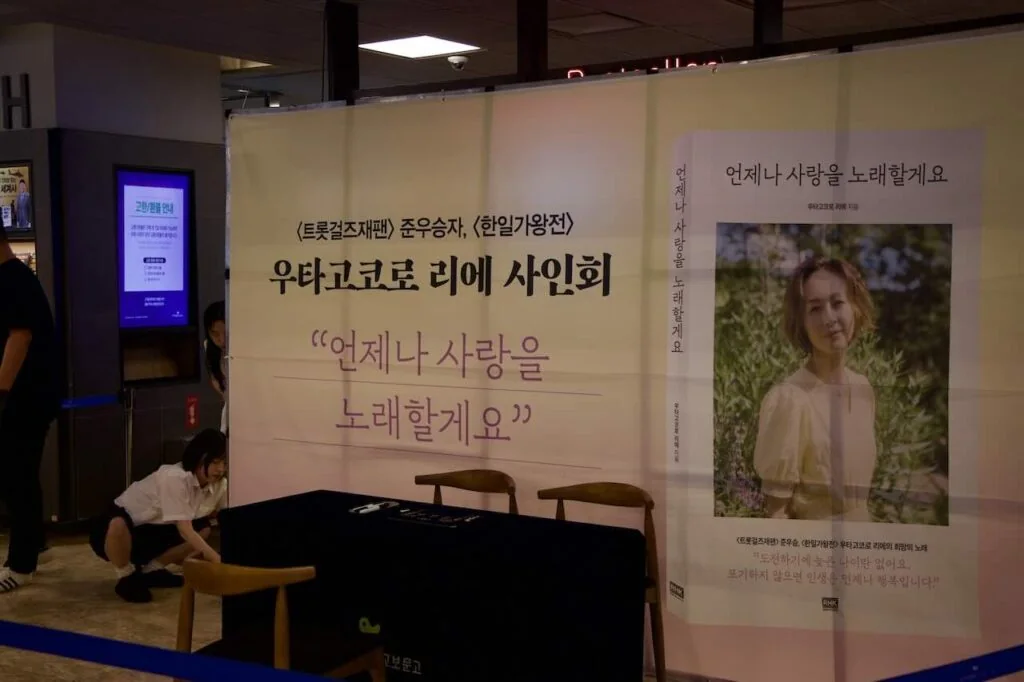
A signing to celebrate singer RIE UTAGOKORO’s first essay collection, whose Korean title translates as “I’ll Always Sing of Love,” took place at 1 p.m. on August 29, 2026, at the Jongno entrance of Kyobo Book Centre’s Gwanghwamun store in Seoul. Participation was limited to the first 100 customers to buy the book at that store that day. Numbered tickets were distributed, one per person, from 9:30 a.m. at the store’s JK desk. Purchases through the Baro Dream service and books bought at other branches were excluded.
Fans were already making preparations before the event began. They bought the book when the Gwanghwamun store opened at 9:30 a.m., received numbered tickets in purchase order and waited for the signing. Because the arrangement combined same-day in-store purchases with first-come, first-served tickets, rather than simply inviting people to arrive for an afternoon event, preparing for the encounter became a morning engagement in itself.
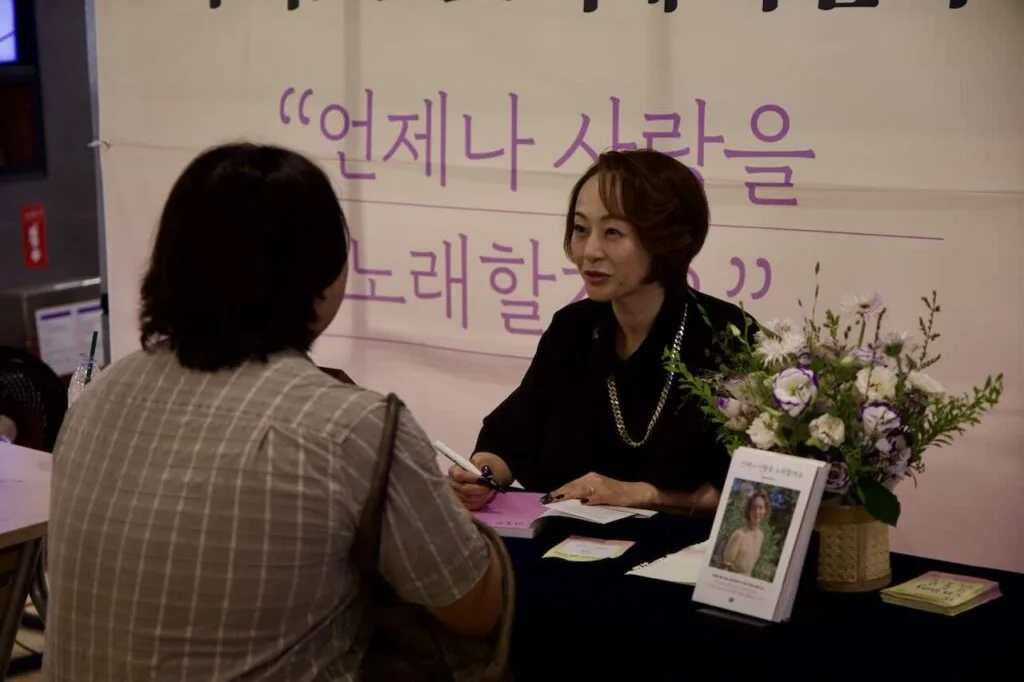
As 1 p.m. approached, participants gathered again near the Jongno entrance. The event began in earnest when RIE UTAGOKORO appeared. In numbered order, each person stepped forward to have their copy of “I’ll Always Sing of Love” signed in person. The basic format was relatively simple, but the few minutes spent getting a signature became small encounters in which Rie and her fans could see one another directly and exchange words.
Brief conversations that outlasted the signature on the page
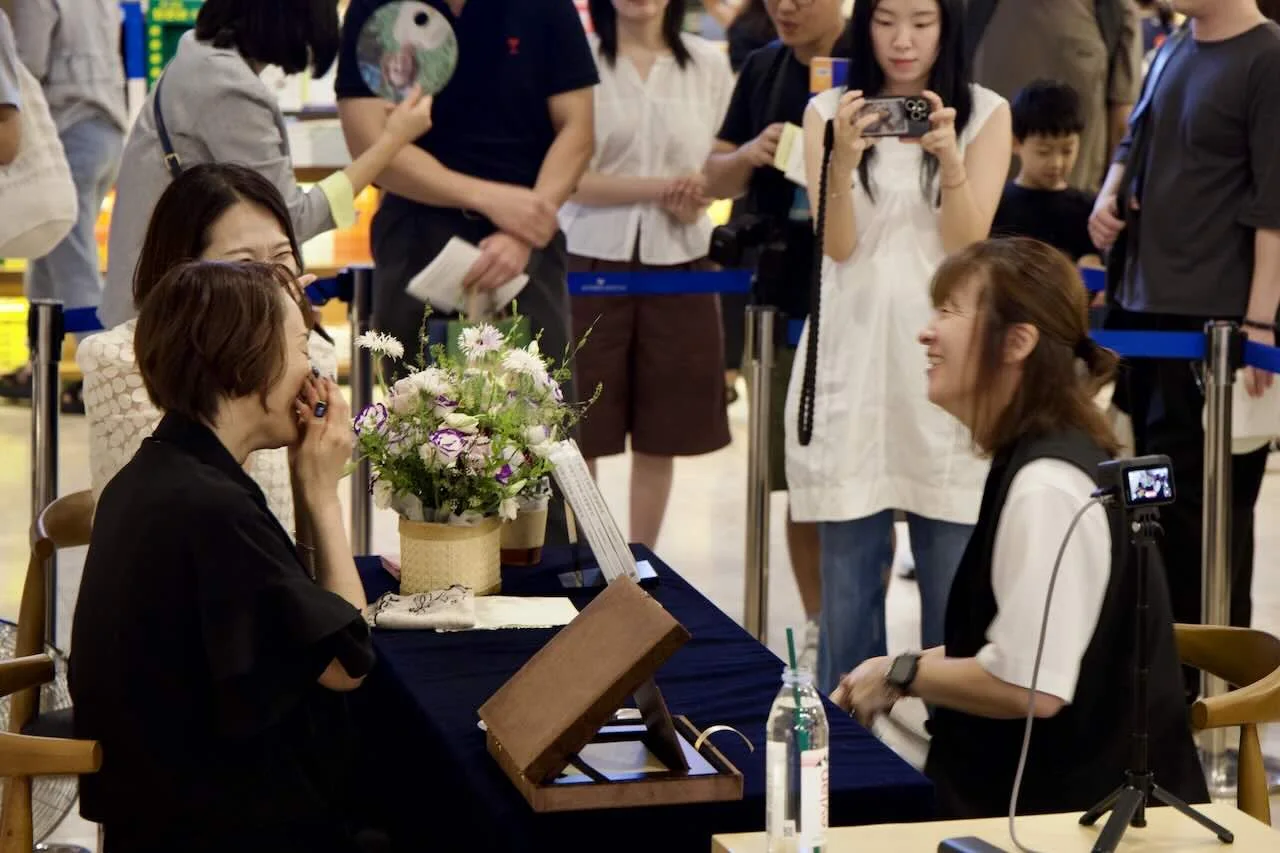
What stood out was a relatively relaxed atmosphere that allowed each participant at least a brief conversation with Rie, rather than a rapid signature and departure. Fans handed over their books and greeted her in turn; as she signed, Rie listened or continued a short exchange. Although the event had a limited timeframe, each face-to-face moment felt less like a procedure for putting a name in a book than an opportunity for fan and author to acknowledge each other’s presence.
Since the event was held in Korea, an interpreter was present to help communication between Korean and Japanese. Some fans could speak to her directly in Japanese, but those who could not were also able to convey their words, and Rie’s answers flowed naturally through interpretation. This was one of the clearest expressions of the event’s character: fans speaking different languages meeting the same artist in one space.
Signings are familiar in both publishing and music, but this was also why this event felt slightly different. Fans meeting a Japanese singer through her first essay collection published in Korea, exchanging brief words across languages with an interpreter between them, could not be explained simply as book promotion. Behind the purchase and signature was a relationship first formed through music; the essay collection extended it into another medium, writing.
A venue where staff also took fans’ cameras
The staff’s response helped soften the overall atmosphere. When participants handed over a camera or phone, staff sometimes used it to photograph the signing or the moment spent with Rie. Fans could preserve the short encounter in photographs or video as well as receive a signature. The organizers naturally showed a willingness to leave fans with positive memories within what was possible.
RIE UTAGOKORO’s husband was also present, filming the proceedings. The camera recorded people stepping forward one by one to receive signatures and talk, along with the atmosphere of the venue; fans likewise captured their own moments on phones and cameras. This helped make the venue feel less like a tightly controlled filming space than a place where fans and artist could comfortably share time within an established order.
That atmosphere ran throughout the signing. With participant numbers and order fixed, the event proceeded fairly steadily, and waiting fans watched others talking with Rie until their own turn. Some received a signature, some offered a brief greeting, and others delivered prepared words through the interpreter. Each person’s time was short, but as those moments repeated, the venue naturally began to move like a fan community.
Mostly Korean fans, with visitors from Japan too
Most attendees were Korean fans, but some were confirmed to have traveled from Japan to Korea for this signing. Korean fans gathering for a Japanese singer’s Korean publication event, and Japanese fans then traveling to Korea to attend it, showed that the fandom around RIE UTAGOKORO is no longer being formed within just one country.
In her first essay collection, “I’ll Always Sing of Love,” RIE UTAGOKORO tells of returning to the stage after years of obscurity and vocal nodules. The official introduction also presents some 30 years without widespread recognition, the difficulties she faced and a renewed opportunity onstage at 50 as central strands of the book. For fans drawn to music that first made a strong impression in Korea, the collection offered another route to reading about the person who had lived through those years, beyond the singer onstage.
The short conversations at the signing therefore carried a context slightly different from a typical author event. Fans who first connected with her through music were meeting the same person again, this time holding a book. Stories conveyed through song had moved into writing, and that book became the meeting point between fans and author. Unlike watching a stage from the audience, meeting face to face one by one could also leave a more personal memory.
A group photograph with fans to finish
As the signing drew to a close, a group photograph was taken with the day’s participants. Fans who had waited individually for signatures gathered in one place and looked toward the camera with RIE UTAGOKORO, recording the event’s final moment. The process of buying books in the morning, collecting tickets and waiting for individual turns ended in a single group photograph.
A signing conducted one person at a time is inherently personal: both the signature in the book and the short conversation belong to each individual. The final group photograph, however, bound those individual experiences into a shared memory. Korean fans, visitors from Japan and RIE UTAGOKORO at the center of the event entered the same frame. The signing thus remained a record of people gathered in one place on one day, rather than simply ending as 100 separate signatures.
From songs to a book, and back to encounters between people
“I’ll Always Sing of Love” matters as RIE UTAGOKORO’s first essay collection, but for Korean readers it also opens a way to encounter her work beyond music. Someone who discovered the singer through one song or performance could read about the years she had lived through and then meet the author at a signing. Interest beginning with music expanded into publishing, and publishing led in turn to an offline encounter.
This signing showed in particular that a fan experience can deepen without a vast stage or elaborate production. A book, a signature, a brief conversation and a photograph were all it took. In that process, fans spoke directly with a singer they liked, and Rie met, one by one, people who had followed her music and life. An interpreter connected the two languages, staff took fans’ cameras to record the moments, and everyone left a shared photograph at the end.
For RIE UTAGOKORO, Korea is becoming difficult to regard merely as one overseas market visited for performances. Her first essay collection appeared in Korean; fans came to Kyobo Book Centre from the morning for its commemorative signing; and even some Japanese fans crossed the border to gather in the same place. Contact with Korean and Japanese fans that began through music was expanding into new forms through a book and an offline event.
Onstage, the song approaches the fan first. At a signing, that relationship briefly moves in reverse. A fan steps forward with a book, and the singer looks at that individual and leaves her name. Those brief encounters together made up the hours spent at Kyobo Book Centre Gwanghwamun that day.
The title of the first essay collection translates as “I’ll Always Sing of Love.” At its first commemorative signing, Rie met fans through a book and brief conversations instead of songs. A story beginning onstage moved into a book and then into a place where people met face to face. In that sense, the signing went beyond announcing a publication: it became a time to reaffirm the relationship already built between RIE UTAGOKORO and her Korean fans.
Encounters connected through songs and a book
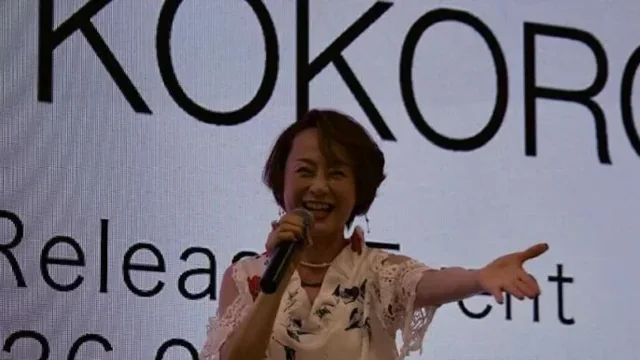
If the Makuhari release event was a place to hear songs and have a recording signed, the Gwanghwamun signing was where fans who remembered that voice brought a book to meet its author. Reading the two accounts together reveals how interest beginning with music continues across different media and spaces.
References
Rie Utagokoro’s UTA and KOKORO Release Event in Makuhari
Rie Utagokoro: Time Together After the Songs — Kawasaki, Part Two
Rie Utagokoro’s Voice at the Fountain Square — Kawasaki, Part One
Trot Girls Japan’s First Japanese Concert: From Television to the Stage
Trot Girls Japan’s “Come Back to Busan Port” Encore: Why Return to the Stage?