REVIEW · Festivals
KANO MIYU and MAKOTO.: Different Songs, One Stage at Seoul’s Korea–Japan Festival
Performance setlist
KANO MIYU / MAKOTO. segment · Performance order
- Cutie Honey — KANO MIYU / MAKOTO.
- Password 486 — KANO MIYU
- Julia ni Heartbreak (Oh My Julia) — MAKOTO.
- Love’s Battery — KANO MIYU / MAKOTO.
- Aoi Sangoshou — KANO MIYU / MAKOTO.
September 22, 2024 Korea–Japan Festival
MIYU’s present at COEX, and ways of standing together
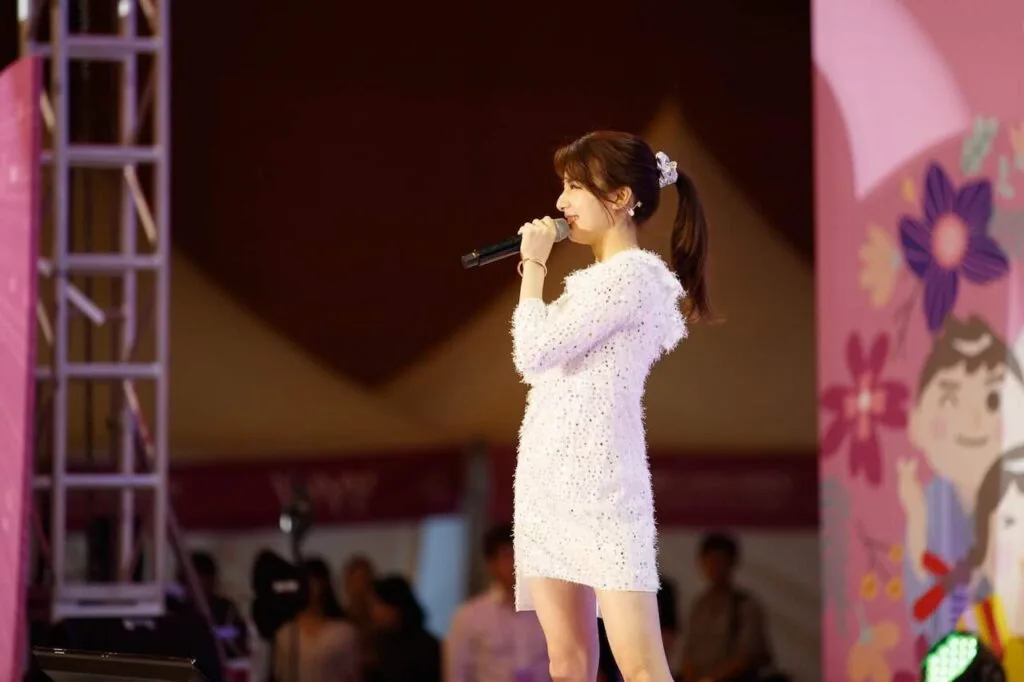
COEX Hall D was a festival rather than a concert hall. Music mixed with food, travel, characters, cosplay, local-government booths and corporate exhibits. Instead of waiting seated, audiences walked, stopped, looked and passed, free to turn elsewhere.
Such space does not favor performers. Without concentrated light or steady applause, singing must prove itself amid noise and movement. Rather than singing to admirers, it is closer to explaining oneself to people who have not decided.
There MIYU and MAKOTO. shared about twenty minutes from 3:30 p.m. Short duration, quick changes and a clear first impression were required. Beyond an invitation, this was an artist proving themselves in a festival space.
A duet beginning and individual languages
Their opening duet was “Cutie Honey.” Familiar melody and light tempo suited the setting. Less technically complex, it must lift the atmosphere at once and signal that the audience may enjoy this stage now.
They understood, neither straining nor brushing it off. They stood neither as rivals nor obscuring one another. Rather than deciding who was better, the duet was a starting point showing the stage working as one team.
The natural shift into individual solos mattered. Sharing a stage, they now had to show the language with which each could persuade audiences.
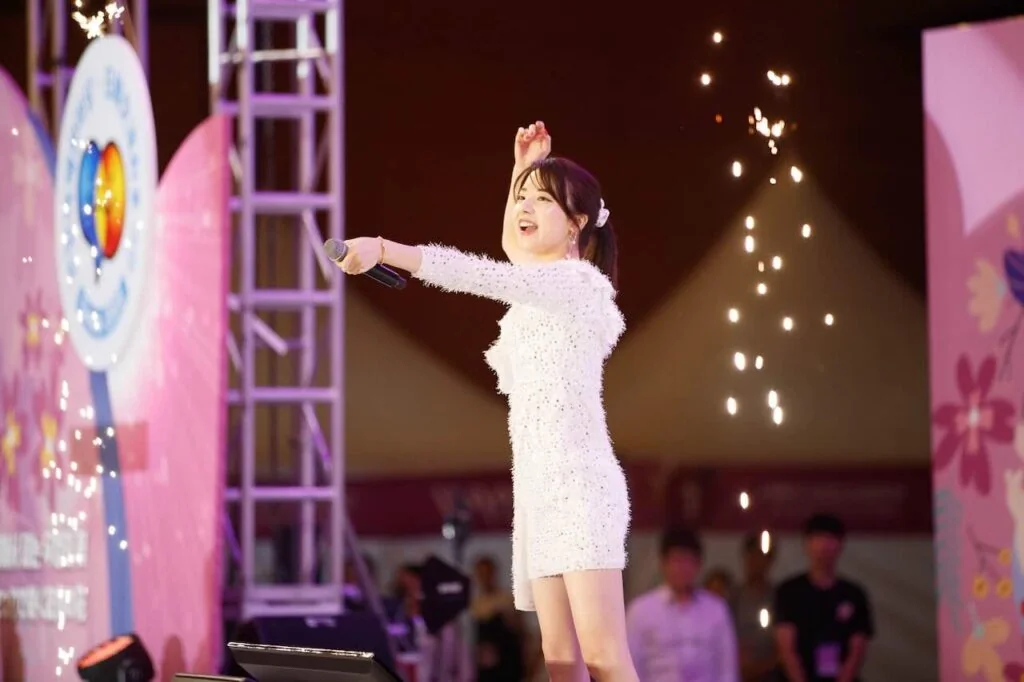
“Password 486” sung completely in Korean
MIYU chose “Password 486,” singing Korean all the way rather than a Japanese version. It carried a clear intention beyond fan service or a one-off event.
For Korean listeners, lyrics may come before melody and memory before emotion. A single misplaced phrase can disturb the impression. Singing it fully in Korean meant choosing to communicate meaning directly before any question of perfect pronunciation.
Her Korean was not flawless: small differences in intonation and unstable pronunciation remained. But she did not avoid imperfection. Instead of safely adapting to Japanese or using Korean only partly, she continued to the end. It was less making it sound good than delivering this song in this language.
There was neither exaggerated feeling nor forced pronunciation. Concentration on the sentence’s flow and stable breath fitting its beat stood out. Even in the distracted festival, the stage-front atmosphere naturally settled and responses emerged clearly as applause and support.
Perfect Korean was not the key. She chose the song and language and sang as if responsible to the end. Rather than introducing herself as a guest from Japan, she stood as someone crossing directly into this space’s feelings and words.

MAKOTO.’s “Oh My Julia”: another way to open space
MAKOTO.’s solo, “Oh My Julia,” had clear character and selection: buoyant rhythm, direct melody and energy immediately fitting the festival. It required no complicated interpretation, reaching toward listeners and quickly receiving reactions.
His strengths became clear in intuitive expressions, bodily movement and audience distance. The mood loosened immediately and mixed naturally with festival openness. It persuaded through felt experience rather than explanation.
MIYU slowly drew listeners inward through language and density; MAKOTO. opened the space through rhythm and energy. One gathered inward, the other expanded outward.
The contrast did not feel competitive. Neither overpowered or obscured the other. Different methods in sequence clarified their colors. Meeting audiences with separate solutions on one festival stage foreshadowed what would follow.
It was less a contest of quality than a scene showing where two people from one starting point had grown in different directions. That balance gave the following story persuasive weight.
The name sis: a choice preserving individuals
Later, they briefly announced plans to begin full activities as sis (SIS/T) with AI ASAHI and RIHOKO TARA. Neither lengthy nor exaggerated, that sentence nevertheless carried weight for witnesses.
They began together on Trot Girls Japan, competing while clarifying their positions through each other. One onstage might make the other a comparison, but neither was entirely pushed aside. Their relationship combined competition and coexistence.
The group announcement extended that relationship. It chose a structure based on differences rather than diluted individuality. For MIYU it meant more than group work: retaining solo identity while trying different stages and timing within a team.
Duets resumed with “Love’s Battery” and “Aoi Sangoshou,” songs suited to a festival, inviting responses without explanation and naturally mixing claps with smiles.
Here MIYU’s attitude shifted from demonstrating Korean pronunciation and communication toward sharing the space. Expressions softened and movement gained a beat of ease. Solo density and duet flexibility did not collide; they continued like two faces within one person.
At the center she also watched those around her. Rather than lead alone, she aligned rhythm with others. It signaled understanding of festival language and quietly showed sis as a workable structure rather than only a project.
Beyond the stage: what festival space means
The scenes did not end on the main stage. At a festival artists share audience space afterward, moving between booths, taking photographs and occasionally meeting eyes.
The finale brought all performers up to dance with audiences. MIYU naturally answered fan requests, creating many two-person photos in brief moments. It felt like a response to the flow rather than planned fan service.
Such scenes matter as much as performance. A festival artist is both performer and participant. She fulfilled both roles sincerely without excess.
What the festival stage left
Several songs passed quickly in roughly twenty minutes, yet the short time offered important clues to understanding MIYU.
She no longer remained only in a survival program’s narrative, but calling her a completed star would be premature. She had reached a point of judging where to stand and which language to choose.
She delivered songs to the end amid noise and openness and kept her center where competition met coexistence. Neither large concert nor solo showcase, the stage made her attitude clearer precisely for those reasons.
Without spectacular lights or inflated presentation, she quietly showed growth through choices and attitude. That kind of proof does not readily fade with time.

KANO MIYU changes the mood from afternoon to evening — Hanno Music Festival 2026

KANO MIYU returns to Fukuoka through song — Daikoku Festival 2026

KANO MIYU and SIS at the crossroads of Kuro Fes 2026
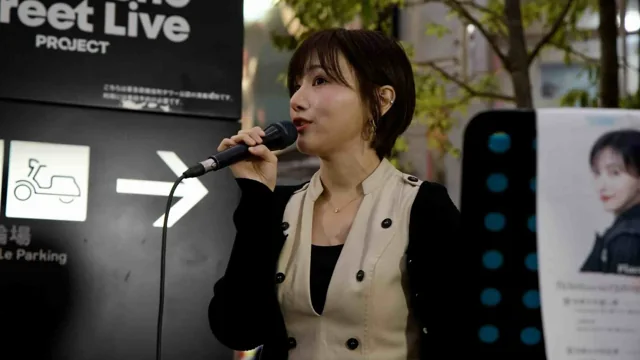
MAKOTO. places her own song among familiar classics — Kabukicho Street Live

sis in Atami, Part 2: Evening Falls on the Same Stage