REVIEW · Festivals
KANO MIYU returns to Fukuoka through song — Daikoku Festival 2026

A new autumn festival at a traditional shrine
The second Daikoku Festival ran from October 2 to 4, 2026, around Tooka Ebisu Shrine and Higashi Park in Hakata, Fukuoka. Launched the previous year, it expanded to three days, combining a shrine event with music, art and community participation.
Known for prayers for business prosperity and good fortune, the shrine presented local cultural activity alongside traditional rites. Taiko, costumed warrior performances and Hakata geisha dance appeared with contemporary popular music. The programme retained the shrine's traditions while making space for younger generations and regional artists.
At 4 p.m. on the final day, KANO MIYU gave a performance offered to the shrine on the lawn in Higashi Park. Having grown up and begun making music in Fukuoka before expanding to Tokyo and Korea, she was returning to a new local autumn festival—a context different from an ordinary commercial concert.
From “OVER DRIVE” to her own music
She opened with JUDY AND MARY's “OVER DRIVE.” Its bright guitar sound and quick rhythm were a fitting lift for an outdoor festival. As an important song in her emergence before Japanese audiences, it also connected the opening to her own musical history.
KANO MIYU · OVER DRIVE
Daikoku Festival 2026
Filming / channel: Diego Watch on YouTube ↗
Minako Honda's “Oneway Generation” followed, along with MIYU originals “DO IT NOW” and “TERMINAL.” The programme set the vitality of 1980s Japanese pop beside her present-day music. Familiar songs established a connection, while original material presented her as an active singer-songwriter.
“DO IT NOW” and “TERMINAL” showed her building a repertoire beyond recreating older hits. Familiar songs can work well at a community festival with varied ages and tastes, but introducing original material is also important to an artist developing a career under her own name.
KANO MIYU · TERMINAL
Daikoku Festival 2026
Filming / channel: Diego Watch on YouTube ↗
TOM★CAT's “Furare Kibun de Rock’n’Roll” returned the show to 1980s rock energy. Alongside “Oneway Generation,” it represented a familiar era of Japanese pop, with MIYU's own songs placed between these established favourites.
KANO MIYU — Performance setlist
KANO MIYU Setlist
Performance order
- “OVER DRIVE” — JUDY AND MARY▶ Watch video
- “Oneway Generation” — Minako Honda▶ Watch video
- “DO IT NOW” — KANO MIYU▶ Watch video
- “TERMINAL” — KANO MIYU▶ Watch video
- “Furare Kibun de Rock’n’Roll” (ふられ気分で Rock’n’Roll) — TOM★CAT▶ Watch video
- “Renbo” (恋慕) — Japanese remake of Lee Ki-chan's “Gamgi”
- “Haikei, Shonen yo” (拝啓、少年よ) — Hump Back song, with local students▶ Watch video
From Lee Ki-chan's “Gamgi” to “Renbo”
The sixth song was “Renbo,” released on September 5, 2026, as a Japanese remake of Korean singer Lee Ki-chan's “Gamgi.” Neko Oikawa wrote Japanese lyrics over the original melody, with Lee credited for composition and arrangement. Preserving the original's feeling while rebuilding it as a Japanese-language work distinguishes it from simply covering the Korean song.
KANO MIYU · 恋慕
Daikoku Festival 2026
Filming / channel: Diego Watch on YouTube ↗
It also connects MIYU's musical experience in Korea to an official release of her own. A Japanese singer performing in Korean is familiar at cultural exchange events. Reinterpreting an existing Korean song in Japanese for release involves another process: choosing it, giving it new lyrics and presenting it as a work in the Japanese market.
That approach belongs to a longer history of Korean and Japanese pop adapting and reinterpreting each other's songs. Music crosses languages to find new singers, lyrics and places in a repertoire. What has changed is how online platforms and international fan communities now make it easier to hear originals and remakes together.
Hearing “Renbo” at a local Fukuoka festival made that movement tangible. A Korean artist's song had been remade in Japanese, released by a singer working in both countries, and brought to a community stage in Japan. It had become an established part of her repertoire rather than a one-off introduction.
“OVER DRIVE,” “Oneway Generation” and “Furare Kibun de Rock’n’Roll” offered familiar Japanese pop, while “DO IT NOW” and “TERMINAL” presented her own music. “Renbo” showed her work in Korea and Japan leading to an actual recording. Songs from different eras and languages met within one setlist.
Closing with local students on “Haikei, Shonen yo”
The most symbolic moment was the final collaboration. MIYU sang Hump Back's “Haikei, Shonen yo” with local students. Where the previous six numbers presented her repertoire and career, the last shared the stage with younger musicians from the community.
KANO MIYU · 拝啓、少年よ
Daikoku Festival 2026
Filming / channel: Diego Watch on YouTube ↗
Released in 2018, the song addresses youthful anxiety, challenges and the pursuit of dreams. Rather than simply promising a bright future, it voices a determination not to abandon one's path amid difficulty and setbacks. That message suited a collaboration with students learning music and beginning to perform.
MIYU herself began in Fukuoka before extending her activities to Tokyo and Korea. A locally rooted musician returning to sing with students just beginning their own journeys added another meaning to the concert. Rather than a one-way lesson from an established artist, they completed a song together on the same stage.
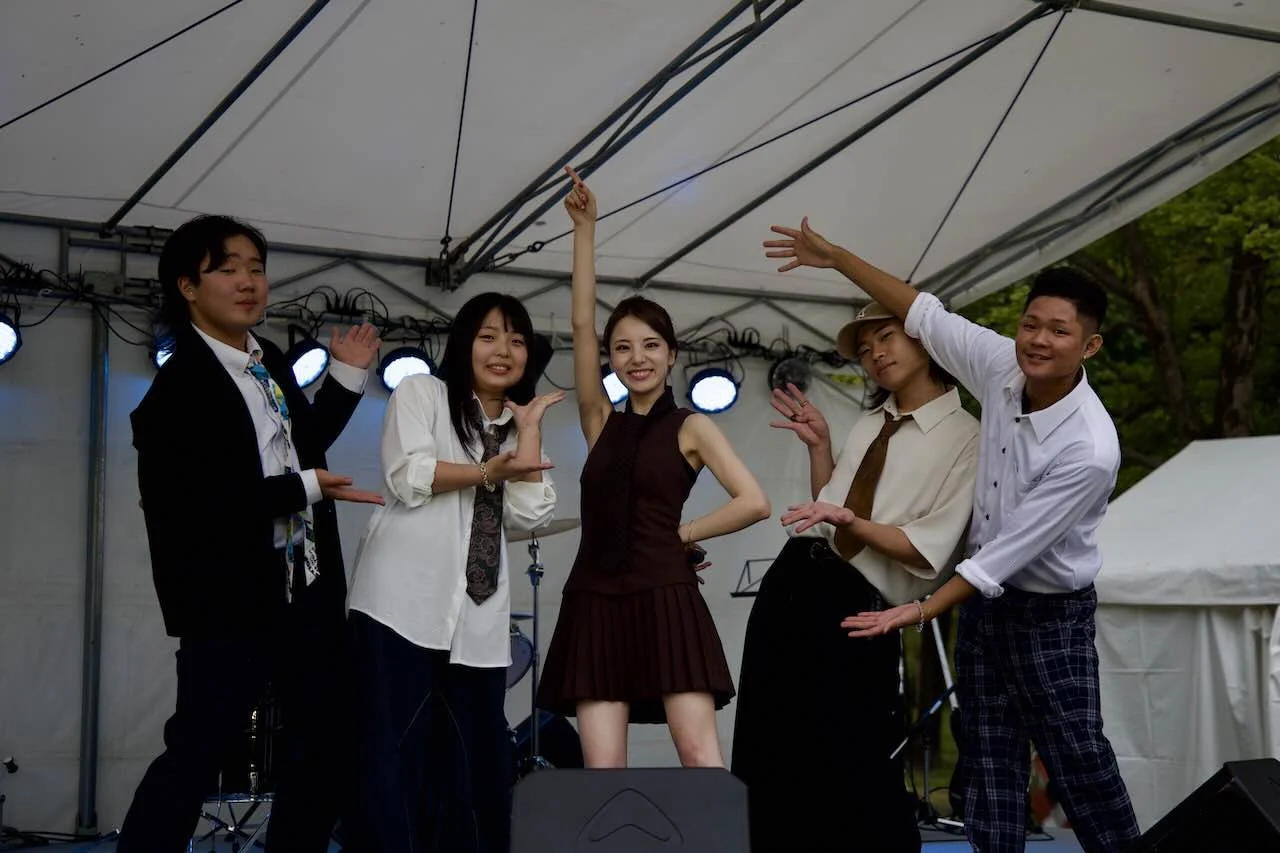
Its place as the final number also made sense. After the lively “OVER DRIVE,” originals and a new song based on Korean music, the set closed with encouragement for young people. Having traced one singer's musical path, the programme turned towards the region's next generation.
One collaboration alone cannot establish a measurable achievement in local music education. Even so, sharing a stage with a singer who grew up nearby can offer students an unusual opportunity. The shrine's festival had created a meeting point between a working artist and young musicians.
There was also time for direct conversation. Local high-school students asked MIYU questions in a Q&A, giving them contact with a working musician rather than only a chance to watch. Given her journey from Fukuoka to Tokyo and Korea, speaking with an artist from an older local generation was notable. Together with the closing collaboration, the programme moved from listening, to asking, to singing together.
How a local festival brings music to new listeners
MIYU's recent work has moved among live clubs, major festivals, street performances and community events. All involve singing for an audience, but the reasons people attend and what they expect can differ considerably.
A club show allows a deeper encounter with people who already know the artist. A large shared concert introduces her to other performers' fans. A community festival also brings residents, visitors and families who came for the event itself. At a traditional shrine, contemporary pop can reach people who rarely visit a live club.
A broad repertoire can help in that setting. Familiar Japanese songs can connect with older listeners; originals introduce the present; a new song based on Korean music shows her activities across two countries. This setlist demonstrated those possibilities.
The officially announced merchandise sale followed the performance. Items included guitar-pick keyrings, random instant photos and the photobook Akiramenaide, with signing information for photobook buyers. Someone discovering her at a free festival could continue that interest through her work and merchandise afterwards.
Combining a free show with merchandise lowers the barrier to attending while giving the artist new points of contact. At a local festival where music may not be a visitor's main purpose, such encounters can become the beginning of further interest.

Music from Fukuoka meets its next generation
Daikoku Festival is still a new event, only in its second edition. How its combination of shrine traditions, local arts, pop and youth performances develops remains to be seen. Its expansion to three days and programmes shared by local musicians and students nevertheless indicate a direction.
MIYU's performance made that character visible. A Fukuoka-raised artist sang Japanese favourites, originals and a new Japanese interpretation of Korean music, then joined students in a song encouraging the young. Music that began locally had travelled through other cities and countries before meeting the region's next generation.
Her work across Korea and Japan was demonstrated through actual songs rather than a spoken list of career milestones. “DO IT NOW” and “TERMINAL” reflected the development of her own music; “Renbo” showed a Korean song becoming a Japanese release; “Haikei, Shonen yo” turned towards the next generation through collaboration.
MIYU, who began making music in Fukuoka, was back on a Fukuoka stage. The songs held memories of Japanese pop, her present-day work and her connections with Korea. At the end stood students just beginning to make music themselves.
On October 4, 2026, the shrine's autumn festival brought MIYU's musical journey and its possible next steps together on one stage.
Related event footage
Related event footage from Diego’s channel.
View all videos · 7

KANO MIYU changes the mood from afternoon to evening — Hanno Music Festival 2026
KANO MIYU and SIS at the crossroads of Kuro Fes 2026

sis in Atami, Part 2: Evening Falls on the Same Stage
sis in Atami, Part 1: Thirty Minutes Between the Sea and Summer Light

KANO MIYU’s Growth: From Fukuoka to Korea, a Singer-Songwriter’s Path