REVIEW · Fan Meetings & Signings
sis at Shinjuku ReNY: A Fan Meeting That Closed the Distance Beyond the Songs

On May 5, 2026, sis (SIS/T) held a fan meeting after its solo concert at Tokyo’s Shinjuku ReNY. The associated post-concert event included Q&A, games, photography and farewell greetings.
Its atmosphere differed from the music- and performance-led concert. Natural conversation and audience participation took priority. Korean visitors joined Japanese fans, helping keep the gathering lively.

The venue’s procedures continue into the fan meeting
Admission began after the venue had been reset following the concert. Tickets were checked again, and the familiar Japanese live-club one-drink system also applied.
Visitors paid an additional ¥700 for a drink voucher to exchange at the venue bar. Common in Japanese live clubs, the extra payment beyond admission can nevertheless feel distinctive to overseas audiences.
Venues such as Shinjuku ReNY often retain the same arrangements for fan meetings as for concerts, making this a recognizable aspect of Japanese live-event culture.
Prediction tickets draw fans into the games
On entry, audiences received a prediction ticket with spaces for the outcomes of three games. Each listed the members’ names, allowing visitors to mark their expected winners in advance.
The format let fans participate rather than merely observe. Even before the event began, conversations developed about who might have an advantage or which member could prove unexpectedly strong.
Fans familiar with the members’ personalities had their own theories. A talkative member might struggle in a forbidden-word game, while someone quick to read a situation could have an edge.
Later, prizes were distributed according to the actual results. Those who predicted every outcome correctly received priority, with additional prizes decided by rock-paper-scissors.
The predictions did more than add an extra feature: they connected the event’s flow. In the relaxed post-concert atmosphere, audiences could participate and react directly, making the room more animated.
Q&A includes questions about “DIVER”
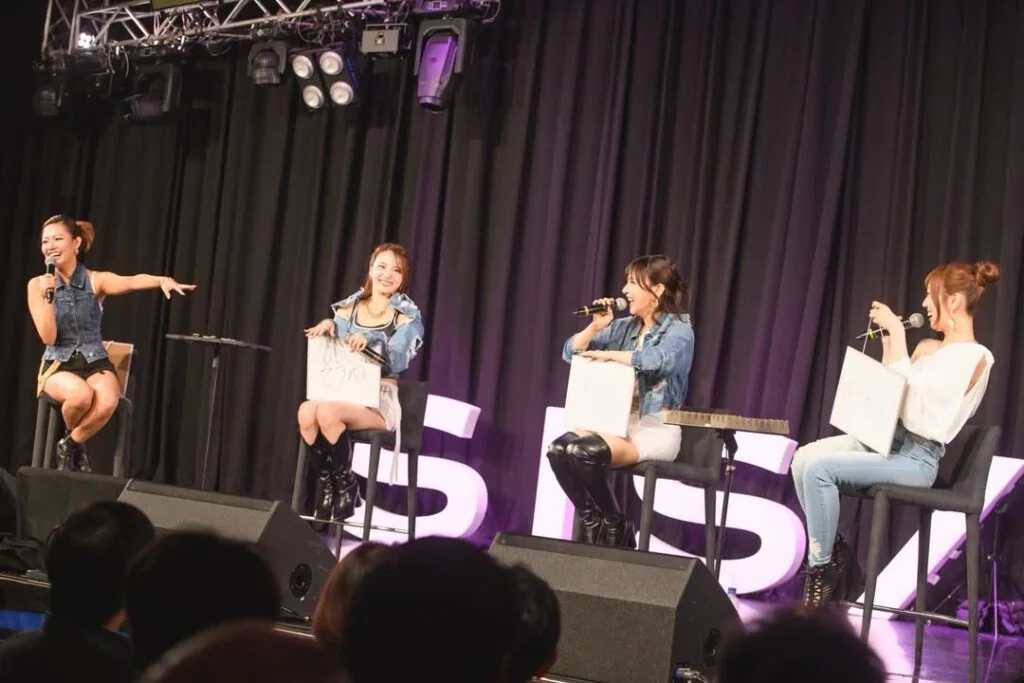
Before the meeting, a question board let visitors post handwritten questions on supplied notes. During the main program, members selected them and responded on the spot.
Topics ranged from recent work and preparation to daily life, backstage stories and practice. Rather than a formal interview, the questions reflected what fans at the venue genuinely wanted to know after the concert.
A question about the new “DIVER” attracted particular interest. Noting its increased emphasis on choreography and performance, it led to discussion of preparation and rehearsal time.
“DIVER” had been among the concert’s most discussed new songs. It foregrounded a contemporary performance-group style beyond sis’s established retro and Japanese-pop image. Reactions that the atmosphere changed instantly when it began reflected a clear distinction from earlier work.
Movement patterns and choreography were more active than before. Where earlier stages emphasized bright, friendly interaction, “DIVER” placed performance itself at the center. Movements changed rapidly with lighting and beats, and group choreography was received as more complex.
Fans described a style they had not previously seen from sis, a stronger K-pop feeling and an apparent increase in rehearsal demands. When members discussed preparation in the Q&A, listeners responded with recognition and laughter.
The segment became more than fan service, offering a closer view of the group’s changing music and stage direction. Questions and reactions around “DIVER” again suggested that Shinjuku ReNY represented a shift rather than merely a continuation.
The forbidden-word game reveals personality and quick thinking
The main activity was a forbidden-word game. Members wrote words for opponents to avoid, then conversed without knowing their own prohibited word. Steering others naturally while avoiding one’s own trap made quick thinking and observation more important than luck.
At first, members were still finding their bearings. Simple questions and reactions led to quick slips, and unexpectedly early eliminations drew laughter. The game began lightly, with players often making mistakes before successfully deceiving anyone else.
As rounds continued, they adapted. More leading questions and psychological tactics appeared, using speech habits and familiar expressions as traps. Players sometimes recognized the setup and avoided answering, increasing audience reactions.
The differences in personality were clear. Some actively unsettled opponents, while others spoke sparingly and carefully. There were unexpected early exits and calm reads of the situation that lasted to the end.
The audience moved beyond observation, laughing at individual choices and cheering each escape from danger. Near-traps produced suspense. In the relaxed atmosphere after the concert, the game revealed the members’ comic instincts and natural chemistry.
RIHOKO TARA won the first round; KANO MIYU won the second and third. The final round remained close enough that rock-paper-scissors was needed to decide the winner, lifting the excitement further.
A photography window near the end
The latter part included time for photographs. Members moved near the audience and posed, allowing relatively free photography.
Because photographs and video had been prohibited during the concert, this was effectively the only opportunity to record the members that day. Given the strict restrictions common at some Japanese shows, audiences welcomed even a short designated window.
Fans tried to capture as many pictures as possible, and members responded with varied poses and expressions. With the concert’s tension released, some visitors felt they saw a more relaxed side than during the main performance.
Some nevertheless wished they could also have photographed the concert outfits. The fan meeting used a different clothing concept, and the well-received “DIVER” styling in particular left people wanting a visual record.
Even so, a final opportunity for personal photographs mattered after a day of restrictions. Capturing the members while the concert’s afterglow remained made it a fitting closing activity.
A farewell line and one last brief exchange
After the meeting, members stood near the exit and greeted audiences as they left individually.
The pace was fast. There was barely time for a word or two, and visitors greeted the members while moving, with almost no chance to stop. After both concert and fan meeting, it naturally left some wishing for a more leisurely goodbye.
Office Walker events have often moved at a brisk pace, a recurring disappointment among some fans. With instant photographs, farewells and benefits passing quickly, they can feel that opportunities to connect are excessively limited.
The approach appears to reflect efficiency and scheduling, but interaction is an important part of idol live culture, prompting calls for more room or at least a little conversation time. Here, despite satisfaction with the concert and meeting, the speed of the farewell was a shared regret.
Nevertheless, greeting the members at close range immediately after the event remained meaningful. Even briefly, fans could express their feelings, while members kept waving and returning short responses to the end.
The fan meeting meant more than a routine follow-up. If the concert demonstrated expanding music and performance, this event offered a closer view of natural personalities and fan relationships. Games, Q&A, photography and farewell greetings carried the concert’s energy forward in a gentler form.
Read the concert and fan-meeting reports together
Related sources

KANO MIYU changes the mood from afternoon to evening — Hanno Music Festival 2026

KANO MIYU returns to Fukuoka through song — Daikoku Festival 2026
KANO MIYU and SIS at the crossroads of Kuro Fes 2026
MAKOTO. places her own song among familiar classics — Kabukicho Street Live

sis in Atami, Part 2: Evening Falls on the Same Stage