REVIEW · Radio & Audio
KANO MIYU and natsuco Reconnect Through Radio — Kanou no SAY!, May 10

In the fifth episode of LOVE FM’s Kanou no SAY!, broadcast on May 10, 2026, KANO MIYU discussed the Hakata Station Sakura Festa, recent work and her connection with the show’s first guest, singer natsuco. Inviting a guest for the first time marked a new moment for the program. A Trot Girls Japan TOP7 member, natsuco is a colleague and friend whose connection with MIYU predates the audition show.
The episode went beyond a routine update, moving through the April 7 Sakura Festa 2026 performance, a short drama filmed in Fukuoka, MIYU’s “Terminal,” natsuco’s city-pop collaboration “Cloudy Moonlight,” and “Re:road” from MIYU’s first photo album, Akiramenaide. Regional stages, music, Korean and Japanese fans, old connections and both artists’ present lives came together in one broadcast.
The fifth Kanou no SAY! on LOVE FM welcomes its first guest
Opening the show, MIYU noted that it was already the fifth episode and that she hosts this slot on the second Sunday of each month. For new listeners, she revisited her background: born in Fukuoka Prefecture, moving to Tokyo at 18, beginning guitar and original songwriting around age ten, and now having roughly 70 self-written songs.
She explained that since the Japan–Korea audition project Trot Girls Japan, she has combined solo work with the unit sis while traveling between both countries. Familiar from earlier episodes, this introduction also established the connection with the coming guest: the program had brought them back together.
MIYU introduced natsuco by announcing the show’s first guest. A fellow TOP7 member who had experienced the demanding audition alongside her, natsuco nevertheless had not first met her there.
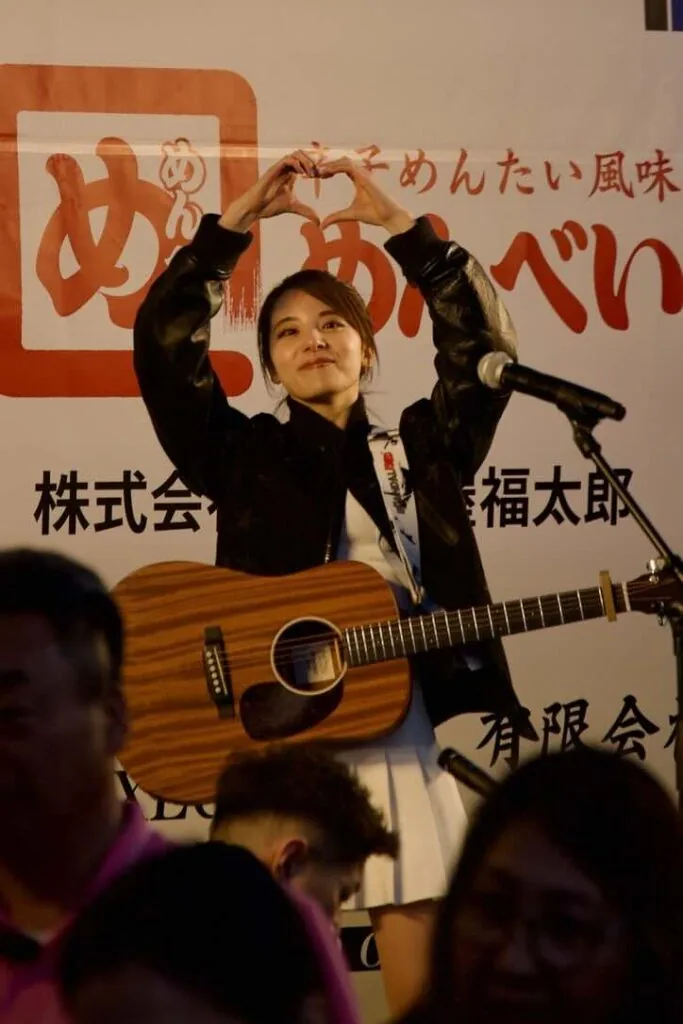
Hakata Station’s Sakura Festa 2026, shared by long-time and Korean fans
Before the guest conversation, MIYU recalled performing at Sakura Festa 2026 at Hakata Station on April 7. It had been a long time since she last sang there, and she was surprised by the larger-than-expected turnout.
She particularly remembered supporters who had followed her since junior high and high school in Fukuoka. Although the stage and audience were some distance apart, her unexpectedly good eyesight let her recognize faces and gestures. She remembered waving back to people greeting her from afar.
She also mentioned fans arriving from Korea. Seeing them travel to Fukuoka, Osaka and other Japanese venues and mingle with Japanese fans warmed her heart, she said. Her recent activities increasingly connect local supporters with the travel and support of Korean audiences.
A Fukuoka short drama released through Mentai Film
MIYU said she had also filmed a short drama during the April 7 Fukuoka event. Released through the TikTok account Mentai Film, it had already appeared on May 5 by the time of the broadcast. She encouraged listeners to watch after the radio show.
The story illustrated how her activities extend beyond music stages. Concerts, radio, fan meetings, short drama and social media form a connected sequence. The fact that the local performance and filming took place in the same area and period suggests Fukuoka is becoming an active base as well as a hometown.
“Terminal,” written with fans in Japan and Korea in mind
MIYU selected her own “Terminal,” describing it as a song written while thinking of listeners in Japan and Korea. Also performed at Hakata Station on April 7, it carries feelings of meeting, parting, movement and memory.
The lyrics heard on air matched the symbolism of a terminal: people meet and separate at countless terminals before continuing along their own paths. The song also overlapped naturally with MIYU’s present life traveling between Japan and Korea.
It was introduced as a favorite of that day’s guest. After playing it, MIYU connected that detail to the conversation, making “Terminal” a bridge between her recent work and her musical connection with natsuco.
First guest natsuco: a connection predating Trot Girls Japan
natsuco appeared after “Terminal.” MIYU introduced her history of childhood choral singing, a Waseda University a cappella club and the grand prize at a Victor Entertainment audition in 2015. She also mentioned the best vocalist award at an international a cappella competition in Incheon in 2017, the Trot Girls Japan final in 2023 and a subsequent TOP7 appearance on Korea–Japan Singer King.
They had not first met on the audition show. natsuco remembered MIYU as already something of a senior within the same circuit in 2015: a black-haired, 15-year-old girl from Fukuoka singing with a single guitar. She recalled a quietly traditional Japanese beauty. An embarrassed MIYU replied that she had been far less polished and sometimes regarded it as a past she would not want to return to.
natsuco countered that the headlong determination of those days had made today’s MIYU possible. The exchange suggested a relationship deeper than a simple professional acquaintance: two people aware of each other since their younger years had met again on shared stages and broadcasts.
A senior and a close friend
Despite an age gap of around five years, they now described themselves as close friends who go to cafés, eat together and share personal stories. MIYU laughed that she knew almost everything about natsuco’s private life, while natsuco’s easy use of “Kanou-senpai” helped create a relaxed atmosphere.
That connection softened the entire broadcast. Rather than formal questions and answers, two people with a long history revisited the past, teased one another and expressed sincere respect.
MIYU’s description of natsuco’s singing as having a mature sensuality and depth she could not produce herself was particularly memorable. Their respect for distinct musical identities emerged naturally.
Before the stage, natsuco keeps her throat warm
The first listener question asked about things they always do or think immediately before performing. natsuco said MIYU had made her notice a habit: she always wears a scarf. She had kept her throat warm since the audition days, and it had become a natural routine.
MIYU called that professionalism. natsuco said she wanted her voice in full condition and carried warm drinks and throat-care products. MIYU recalled sharing a hotel room during Korean activities and being surprised by her warm honey drink and throat remedies.
In return, natsuco said MIYU recommended beauty products such as good oils and body creams, showing how they influence each other.
Skin care, moisture and differences in beauty culture
The next question concerned skin care. Asked what she did for her clear skin, natsuco joined MIYU in concluding that moisture mattered. MIYU mentioned using facial mist before flights, while natsuco noted women using mist on streets and in restaurants in Korea.
The conversation moved to differences between Japanese and Korean beauty habits. MIYU recalled seeing a Korean tourist paying at a Japanese convenience store while wearing a mud mask, suggesting that something relatively ordinary in Korea could look surprising in Japan.
Though light and humorous, the conversation also showed her experience of Korea as a place of everyday living and culture, rather than only a work destination.
Experience does not let you down: age and values
Asked what she paid attention to as a woman, natsuco explained that she was now in her thirties and worked weekdays in graduate recruitment. Introducing her company to students, she said, naturally reveals the speaker’s character and values.
As people age, appearance still matters, but experience and accumulated values eventually emerge in their words, behavior and singing. That made varied experiences important to her.
MIYU said she had recently been writing original songs and agreed that experience matters for lyrics. natsuco’s observation that how someone describes a scene reveals character connected naturally with MIYU’s life as a singer-songwriter.
Personal training on days off: a body prepared for singing
natsuco said she spends days off at personal training. The purpose was not simply appearance: both discussed the importance of core and abdominal strength for singers. Supporting high notes and a stable voice onstage requires strength at the body’s center, they explained.
MIYU said she also intended to keep up core training. She added that defined abdominal muscles are common among recent K-pop idols and female artists and that Pilates has become widespread.
natsuco’s “Cloudy Moonlight,” feelings in city-pop form
Later, the broadcast introduced “Cloudy Moonlight.” natsuco explained that she featured as a vocalist in the Little Star-related L.S.C.M. project after someone who heard her on Trot Girls Japan invited her to participate.
The city-pop-based song was introduced as expressing a woman’s difficulty being honest about her feelings. MIYU joked that natsuco shared that trait, and natsuco admitted she was not someone who readily opened up.
MIYU encouraged listeners to pay attention to the chorus lyrics and praised the fit between natsuco’s voice and the song’s mood. The program also noted its availability on JOYSOUND karaoke.
The first photo album, Akiramenaide., and “Re:road”
In the latter part, MIYU returned to her first photo album, Akiramenaide., asking those who had not heard or purchased it to explore the work. She selected “Re:road” from it.
This was also introduced as one of natsuco’s favorites. Where “Terminal” had acted almost as a guest recommendation earlier, “Re:road” provided another emotional thread representing the photo album.
Its lyrics carried images of time passed, precious memories, sadness, gratitude and promises to keep. In a program connecting past relationships, current activities and future stages, the placement felt particularly natural.
Next broadcast June 14: a new dimension for the show
At the close, MIYU thanked natsuco again and repeated the announcement of her July 25 solo live show. She directed listeners to social media for her own updates and announced the next broadcast for Sunday, June 14, at 2:30 p.m.
The fifth episode expanded the program’s format. Previously, MIYU had introduced updates, music and listener letters alone. The first guest brought a richer sense of relationships and greater conversational depth.
It showed her present life from three directions: Fukuoka-based work connecting Hakata Station and short drama; her own musical narrative through “Terminal” and “Re:road”; and long-standing relationships with fellow artists revealed through natsuco.
More than simply a special guest appearance, the episode became a record of the people she has grown alongside and the stages and music through which she is broadening her possibilities.
Related sources

KANO MIYU changes the mood from afternoon to evening — Hanno Music Festival 2026

KANO MIYU returns to Fukuoka through song — Daikoku Festival 2026

KANO MIYU and SIS at the crossroads of Kuro Fes 2026

sis in Atami, Part 2: Evening Falls on the Same Stage

sis in Atami, Part 1: Thirty Minutes Between the Sea and Summer Light