REVIEW · Concerts & Live
KANO MIYU at Salon Moonbow: Entrusted with the End of the Day
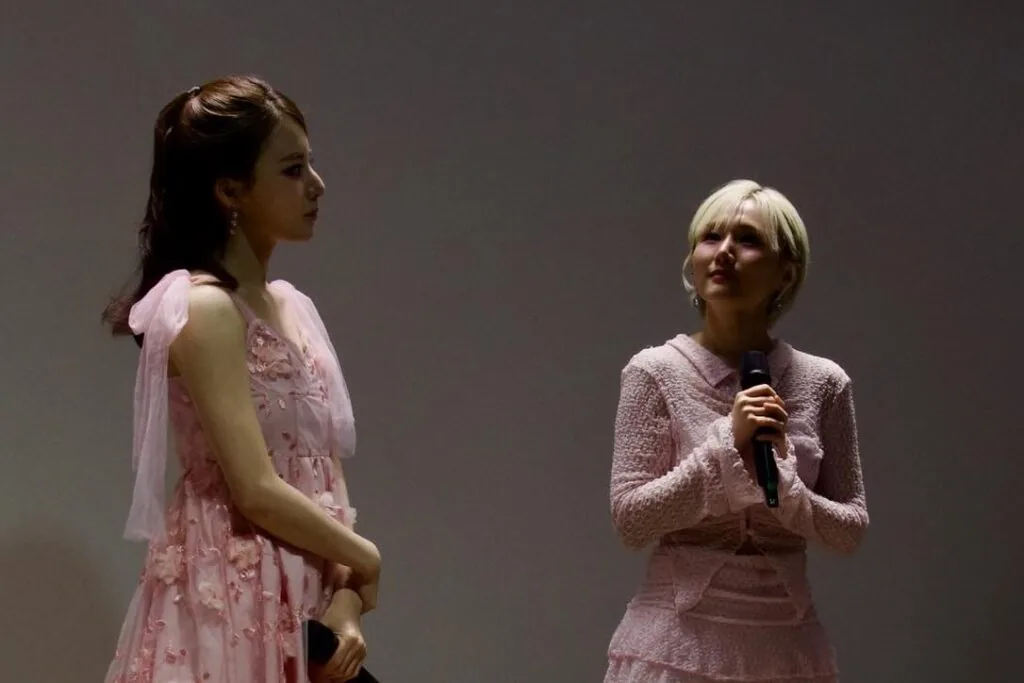
26 May 2025, Salon Moonbow
Entrusted with the End of the Day
In Seoul’s Hapjeong neighborhood, Salon Moonbow feels more like a room for encountering music closely than a conventional venue. Around 80 people fit with little physical separation from the stage. Expressions and breaths reach listeners; attitude matters more clearly than volume or elaborate staging.
A two-day relay concert in May brought artists with individual themes across several sessions. The final stage belonged to KANO MIYU, closing both the day and the two-day flow.
Closing means more than placement: the audience’s stamina, concentration and emotional reserves are already spent, yet a highlight is expected. Miyu faced that responsibility.
Choices Made for Front Positions
Seats were not assigned; queues admitted all-pass holders, day-pass holders, single-show ticket holders in that order. Securing the front effectively required an all-pass.
Some reluctantly bought one for Miyu; around two people even skipped the preceding show to queue. They came less for a continuous program than to see KANO MIYU herself.
It quietly suggested a performer becoming a destination rather than one option.
MAKOTO. as Host
The MC was MAKOTO.. Brief appearances for Q&A and either-or games showed fluent Korean–Japanese switching and the natural rapport of SIS/T teammates.
Questions, transitions and returning the stage to Miyu were handled without excess. Rather than take control, MAKOTO. read her rhythm and made space for the next song—a fellow performer’s understanding beyond simple hosting.
What the Setlist Revealed
— Choices Made for a Korean Stage
The running order was as follows.
Concert setlist
Running order
- Over Drive
- Ai wo Tsutaetaidatoka
- Don’t you see
- Ruriiro no Chikyu
- Every Heart (BoA)
- Moonlight Densetsu
- Samishii Nettaigyo (with MAKOTO.)
- Romantic Ageru yo
- Watashi ga Obasan ni Nattemo
- Nado Yeojar apnida
- Kawaikute Gomen
The sequence suggested a clear direction rather than chance.
The first two songs had defined her Korean appearances through Korea–Japan King of Singers and later stages. Beyond proven popularity, they quickly explained the kind of performance she creates.
She did not display power for its own sake, instead using the room widely and gathering attention gradually. The impression was less merely a skilled singer than someone who can manage a stage reliably. Not forcing emotion to extremes immediately suggested an appearance intended to lead beyond a one-off event.
“Don’t you see” and “Ruriiro no Chikyu” differed. Choosing Japanese classics here seemed less an appeal to familiarity than a wish to introduce their emotional texture to Korean audiences.
With ZARD’s signature song, she trusted feeling to cross language. Rather than announce a Japanese-song showcase, she relied on flow and melody without unnecessary explanation. The result settled quietly rather than feeling alien.
BoA’s “Every Heart” and “Moonlight Densetsu” addressed Korea more directly. The former, familiar in both countries, also symbolizes a career moving from Korea into Japan, echoing Miyu’s own position as a Japan-based performer appearing in Korea.
The latter was not merely nostalgia: its bright character loosened accumulated density, refreshed the flow and narrowed the distance.


The later selections leaned further toward Korea.
“Romantic Ageru yo,” “Watashi ga Obasan ni Nattemo” and “Kawaikute Gomen” had been well received on Hanil Top Ten Show. Revisiting them meant positioning trusted interpretations rather than testing novelty.
“Nado Yeojar apnida,” an older Korean popular song with a clear emotional and verbal character, sat at this flow’s center. Singing it in Korean respected its linguistic rhythm, moving beyond a foreign-guest frame toward a performer sharing the same space.
The program layered songs already meaningful in Korea, songs introducing Japanese sensibilities and repertoire symbolically connecting both countries. Neither random nor overambitious, it looked beyond a first presentation toward future appearances.
Rather than prove a new self, Miyu gathered established choices again, made clearer by the small room.
The Relationship in a Duet
MAKOTO. returned for “Samishii Nettaigyo.” Knowing their path from competitors on Trot Girls Japan to SIS/T colleagues made this more than a guest segment: it carried a story.
Their voices remained distinct, without one merely supporting or claiming the center. Each left space without intruding, standing together in different textures. More than flawless coordination or ornate harmony, what mattered was a distance that did not push either aside.
It reaffirmed Miyu’s capacity to retain individual color within a team: balance after competition and respect for separate domains. Its later placement felt meaningful too.
The Last Song and What Remained
After “Kawaikute Gomen,” applause continued rather than exploded. It marked an ending and a sense of fulfillment. Sustained clapping instead of loud cheers suited the room and mood.
The stage calmly showed her present level rather than a new challenge. Fans made choices to be close; she carried the closing slot and kept a center across languages and genres.
Without straining to prove herself, she placed her abilities precisely: wide use of space, restraint in the middle and renewed audience exchange later. These felt less like attempts to impress than the most stable way to stand as she was now.
The room held listeners to the end because its performer understood her task, not because of extravagant surprises.
Merchandise, Instant Photos and the Room’s Temperature
Badges used a random-draw system; individual member instant photographs cost ₩15,000, and a photograph together cost ₩25,000. First-come sales quickly drew queues.
Some left disappointed. Management was imperfect and expectations were not all met, reflecting small-venue constraints. The performance’s concentration nevertheless remained intact.
Photographs followed all performances, helping protect concentration. Miyu remained someone singing to the end rather than someone being photographed; exchange with listeners came before the camera.
A Clear Impression from a Small Stage
Neither a major concert nor a spectacular showcase, it nevertheless showed someone becoming able to carry such a stage through to the end. Closing and handling that weight without exaggeration were no accident.
She quietly ordered accumulated choices and attitudes rather than inventing a new story. That impression lasts longer than loud sound.
As these stages accumulate, a singer demonstrating promise becomes a performer who can be trusted. The change was unhurried but clear and steady.

KANO MIYU changes the mood from afternoon to evening — Hanno Music Festival 2026

KANO MIYU returns to Fukuoka through song — Daikoku Festival 2026

KANO MIYU and SIS at the crossroads of Kuro Fes 2026

sis in Atami, Part 2: Evening Falls on the Same Stage

sis in Atami, Part 1: Thirty Minutes Between the Sea and Summer Light