REVIEW · Broadcast & Video
KANO MIYU’s “Password 486”: naming the terms of an open heart
Karaoke song codes
A password must be known before entry. “Password 486” turns that rule into romantic language. Its speaker supplies conditions rather than assuming that saying “love” opens a heart. The person receiving affection can state what she wants.
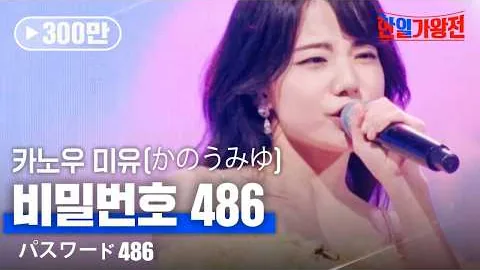
KANO MIYU performed Younha’s song on episode 3 of MBN’s Korea–Japan King of Singers, broadcast April 16, 2024. Korean repertoire enters a Japanese contestant’s selection, crossing the programme’s national division in another direction.
KANO MIYU — Password 486 | Korea–Japan King of Singers, Episode 3
Rules made by the person receiving love
The speaker does more than accept any affection offered. Familiar phrases and established dating conventions will not automatically produce her desired relationship. A person standing before a door cannot alone determine how it opens.
Numerical love is an intriguing idea. Feelings are hard to measure, while numbers look exact. The gap creates playful confidence. The song need not offer a calculation applicable to every couple. Its concrete act is someone asking to be treated in her own way.
A character inside a short title
Wheesung wrote the original words and Hwang Chan-hee composed. The title builds a small puzzle instead of naming an emotion directly. A newcomer wonders what the numbers mean; someone familiar recalls the speaker through them. A brief sign holds a character in memory.
Knowing a password is different from understanding a person completely. The rule can invite a relationship without becoming a manual that fixes a heart permanently. Interest beyond repeating a memorised answer remains necessary. That opening makes the title’s boldness more interesting than a simple demand.
A song already moving between languages
A Japanese version also has an official release history. Sony Music’s 2008 announcement for Songs: Teen’s Collection lists “Password 486 -Japanese version-.” Both titles preserve the central password-and-number device.
This widens the context for a Korean–Japanese television cover. A song already voiced in more than one language reaches another singer. The original performer’s route and the cover stage meet briefly beneath a shared title.
Leave room for the song’s speaker alongside points and nationality: someone telling a loved person how she wishes to be treated. Three digits make that voice memorable, but the relationship inside remains more open than a number.
KANO MIYU · Password 486
Road to Bu-Rock · Fukuoka
Filming / channel: Diego Watch on YouTube ↗
Music and production information
MBN MUSIC · KANO MIYU: Password 486, episode 3 ↗ · Bugs · Younha: Password 486 ↗ · Sony Music · Younha: Songs—Teen’s Collection release ↗
Related event footage
A separate live interpretation of the same song is included here. The video title and performance context are identified below.
View all videos · 1

KANO MIYU changes the mood from afternoon to evening — Hanno Music Festival 2026

KANO MIYU returns to Fukuoka through song — Daikoku Festival 2026

KANO MIYU and SIS at the crossroads of Kuro Fes 2026

sis in Atami, Part 2: Evening Falls on the Same Stage

sis in Atami, Part 1: Thirty Minutes Between the Sea and Summer Light