REVIEW · Release Events
MIRAI FUKUDA’s “Motto Sayonara”: two stages shaped by the same new single

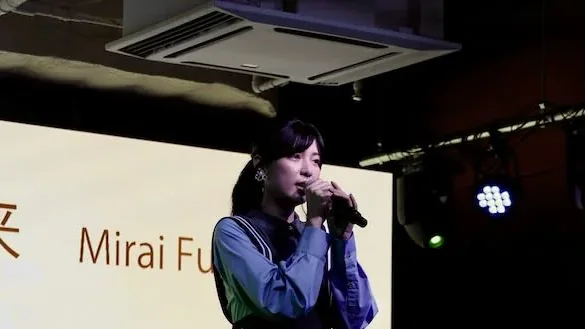
On September 5, 2026, MIRAI FUKUDA held a release event for her debut single “Motto Sayonara” (もっとサヨナラ) at Event Space B on the fifth floor of HMV & BOOKS SHIBUYA in Tokyo. The event was divided into two sessions, at noon and 2:30 p.m. Both comprised a mini-concert, audience Q&A and a special interaction session for CD purchasers.
The release events centered on “Motto Sayonara,” released August 26, began the day before release, August 25, at MAGNET7F CROSS STAGE SHIBUYA. They continued at HMV & BOOKS SHIBUYA on release day, HMV Esola Ikebukuro and Tower Records Kinshicho PARCO. About a week later, she returned to Shibuya for two performances in one day before moving to Nikke Colton Plaza in Chiba on September 6. While new music can appear online almost instantly in the streaming age, MIRAI FUKUDA was continuing a traditional release promotion: taking one single to different places and meeting audiences repeatedly in person.
If the first event, held on the eve of release, centered on the fact that MIRAI FUKUDA was finally presenting a solo major-label debut song under her own name, the situation had changed slightly by September 5. The single was already out and its music video had been released. What mattered now was less announcing that a new song existed than how often audiences could hear “Motto Sayonara” and come to remember it together with the name MIRAI FUKUDA.


Performing twice in one day with one single
The two sessions shared the same basic framework. Both began with “Motto Sayonara,” followed by the accompanying track “Hidamari 2026” (陽だまり2026). Between songs, MIRAI FUKUDA selected and answered some questions submitted in advance by the audience. Each set ended with another performance of “Motto Sayonara,” and photography and video recording were permitted for that song alone.
Keeping the central repertoire was natural when promoting the same single at the same venue on the same day. One of a release event’s key purposes is to expose listeners to a new song as repeatedly as possible. Placing “Motto Sayonara” at both the beginning and end of each performance made that aim explicit. Audiences heard the new song as the show began, then experienced it again at the end while recording it themselves in photos and video.
The two shows did not, however, repeat exactly the same stage. The clearest change was the cover: Momoe Yamaguchi’s “Bi Silent” (美・サイレント) in the noon session and Mariya Takeuchi’s “Eki” (駅) at 2:30 p.m. A change of outfit also provided distinctly different scenes for those attending both performances.
Part 1 — 12:00
Setlist
Performance order
- “Motto Sayonara” (もっとサヨナラ)▶ Watch video
- “Hidamari 2026” (陽だまり2026)
- “Bi Silent” (美・サイレント) / Momoe Yamaguchi
- “Motto Sayonara” (もっとサヨナラ) — Photography and filming permitted▶ Watch video
Part 2 — 14:30
Setlist
Performance order
- “Motto Sayonara” (もっとサヨナラ)▶ Watch video
- “Hidamari 2026” (陽だまり2026)
- “Eki” (駅) / Mariya Takeuchi
- “Motto Sayonara” (もっとサヨナラ) — Photography and filming permitted▶ Watch video
Placed side by side, the two sets made the event’s design clearer. The two new songs and the final filming-permitted performance remained fixed, while the cover between them changed. It kept the promotional focus intact while giving those attending both sessions a reason to hear another song.
“Bi Silent” and “Eki”: the difference made by two covers
The first set’s “Bi Silent” and the second set’s “Eki” were an intriguing pairing to view as merely two songs filling time. They connect respectively to Momoe Yamaguchi and Mariya Takeuchi, major names in Japanese popular music, while MIRAI FUKUDA’s debut single itself proposes bringing the sensibility of late-Showa city pop and kayokyoku into the present.
“Bi Silent,” chosen for the first session, was released by Momoe Yamaguchi in 1979. Almost half a century separates it from MIRAI FUKUDA’s new songs, yet a contemporary vocalist singing older Japanese popular music in her own voice naturally connects with the musical direction of “Motto Sayonara.” On Trot Girls Japan and other stages, MIRAI FUKUDA has interpreted a varied popular-song repertoire rather than confining herself to one era or genre. That experience remains an important asset as she now sings new material released under her own name.
Mariya Takeuchi’s “Eki,” selected for the second session, created a different color. A significant part of the repertoire of an artist representative of 1980s Japanese pop, the song has been sung across generations for many years. By delivering a song in which narrative and emotional movement matter more than forceful performance, MIRAI FUKUDA gave the second session a different mood from the first, even though both included “Motto Sayonara” and “Hidamari 2026.”
Changing a single cover can alter the impression of an entire concert. That effect is especially strong in a short mini-concert built from three distinct songs. Choosing different covers for the two sessions can be read as an attempt to make repeat attendance meaningful through even a small change, rather than simply copying the show at a different time.
Older popular songs and MIRAI FUKUDA today
These two covers also matter when considering MIRAI FUKUDA’s present position. “Motto Sayonara” features lyrics by Takahiro Maeda, music by Takao Kisugi, and arrangement and production by Satoshi Takebe. The label likewise describes it as kayokyoku that retains a strong late-Showa city-pop color while adding a contemporary sensibility.
The accompanying “Hidamari 2026” also has lyrics by Takahiro Maeda, with composition and arrangement by Toshiyuki Omori, known for works including “A Cruel Angel’s Thesis” (残酷な天使のテーゼ). The two songs on this one single already reveal MIRAI FUKUDA’s voice from different directions through different composers and arrangers.
The live performance added songs by Momoe Yamaguchi and Mariya Takeuchi. Seen this way, older Japanese popular music did not oppose the new songs in this show. It was closer to one of the foundations MIRAI FUKUDA needed to begin her own music now: moving from a singer able to perform older songs to an artist who understands that musical language and has new songs bearing her own name.
This also explains why her solo major-label debut looks somewhat different from a straightforward newcomer’s debut. She was making a new start under her own name after already experiencing different group activities, auditions and performances between Korea and Japan. What these release events show is therefore less a newcomer learning to sing for the first time than an artist considering how to rearrange her accumulated repertoire and experience within her solo music.
A release event that goes beyond buying a CD
CD purchasers received priority admission and access to special interaction sessions, but non-purchasers could also watch the mini-concert as space allowed. Purchasers gained the possibility of a better viewing position and direct fan experiences such as handshakes and two-person photos; people who happened to visit the store could encounter live music without buying a separate concert ticket.
Within this structure, the CD functions as more than a physical product containing music. Even when the recording can already be streamed, buying a CD adds experiences such as priority admission and a special interaction session. Purchasing the recording connects to meeting the artist directly. At the same time, retaining free viewing space lowers the barrier for audiences who have not yet bought it.
This is also part of the reason for holding two shows a day. The same fan can attend twice, but someone unable to come at noon may make the afternoon session. Indeed, the second show that afternoon visibly drew more people than the first. Rather than gathering everyone into a single performance, the event increased points of contact by dividing the times and varying the content slightly.
Compared with a major concert, a release event is small. For a singer presenting a new song, however, the accumulation of these modest encounters matters. The distance to each listener shrinks, opportunities to hear the song in person increase, and photographs and videos made by fans move online after the show. A small event beginning offline can thus lead to a new song spreading online.
Why the final “Motto Sayonara” could be filmed
Photography and video recording were restricted through most of both shows, but permitted for the final “Motto Sayonara.” The atmosphere in the audience visibly changed at that point. People who had been watching the performance took out cameras and smartphones and began recording the same song in their own ways.
Considering the purpose of a release event, this was an effective arrangement. Instead of letting audiences record the whole show, it directed their attention to the live performance for most of the time and let them freely document the final new song. The content most likely to reach social media would consequently be this single’s title track.
It is therefore difficult to view the decision to place “Motto Sayonara” at both the beginning and end as merely a shortage of songs. The first performance let the audience experience the song fully; the last let them take that experience home as a personal recording. The same song was sung twice, but received differently each time.
Across the two shows that day, MIRAI FUKUDA sang “Motto Sayonara” four times. That may sound like considerable repetition, but it is precisely the nature of release promotion. A new song does not immediately become a singer’s signature repertoire simply because it has been released. Singing it, singing it again and moving elsewhere to sing it once more gradually builds the song and the singer’s name together.
A song’s life begins after release
“Motto Sayonara” had officially been released on August 26. The recording was available and the music video was out. Yet the two September 5 performances at HMV & BOOKS SHIBUYA showed that a song’s starting point for a singer does not necessarily coincide with its release date.
Release makes music available to reach listeners. Leaving that song in people’s memories is a subsequent task. MIRAI FUKUDA took “Motto Sayonara” to stores and event spaces in different cities and continued singing the same song. Along the way, she changed covers and outfits and spoke with audiences, making small differences between individual shows.
The two September 5 sets offered a day on which that release-event structure could be compared. Momoe Yamaguchi’s “Bi Silent” in the morning and Mariya Takeuchi’s “Eki” in the afternoon stood beside “Motto Sayonara.” Showa-era kayokyoku, 1980s Japanese pop and MIRAI FUKUDA’s new song released in 2026 intersected within one singer’s voice over the course of a day.
The title of Trot Girls Japan winner was an important starting point in making MIRAI FUKUDA known. Ultimately, though, the songs left under her own name will build her future career. More important than the fact that “Motto Sayonara” has been released is how long it will continue to be sung and how many listeners will remember it together with her name.
The “Motto Sayonara” heard twice in Shibuya was thus closer to a new song becoming part of a singer’s repertoire than to a repetition of the same show. An artist who has carried earlier classics forward through her own voice is beginning to place her own music among them. MIRAI FUKUDA’s solo major-label debut was not an event that ended with the August 26 release; it is being made now as she continues to sing that song in front of audiences.
From the eve of release to the stages that follow
The August 25 and September 5 performances record different moments while placing the same single at their center. Reading the first encounter before release alongside the selections from the two later sessions traces how one song reaches an audience.
Read the review of MIRAI FUKUDA’s August 25 solo debut performance →
References
Related event footage
Related event footage from Diego’s channel.
View all videos · 2
MIRAI FUKUDA’s Solo Major-Label Debut Stage: “Motto Sayonara”
Trot Girls Japan’s First Japanese Concert: From Television to the Stage

natsuco, MAKOTO. and MIRAI FUKUDA: Three Voices in “Stay With Me”

KANO MIYU and MIRAI FUKUDA’s “Heavy Rotation”: Reinterpreting Idol Pop
Trot Girls Japan’s “Come Back to Busan Port” Encore: Why Return to the Stage?