REVIEW · Release Events
MIRAI FUKUDA’s Solo Major-Label Debut Stage: “Motto Sayonara”
Featured release-event songs
Featured repertoire · not in performance order
- Motto Sayonara
- Hidamari 2026
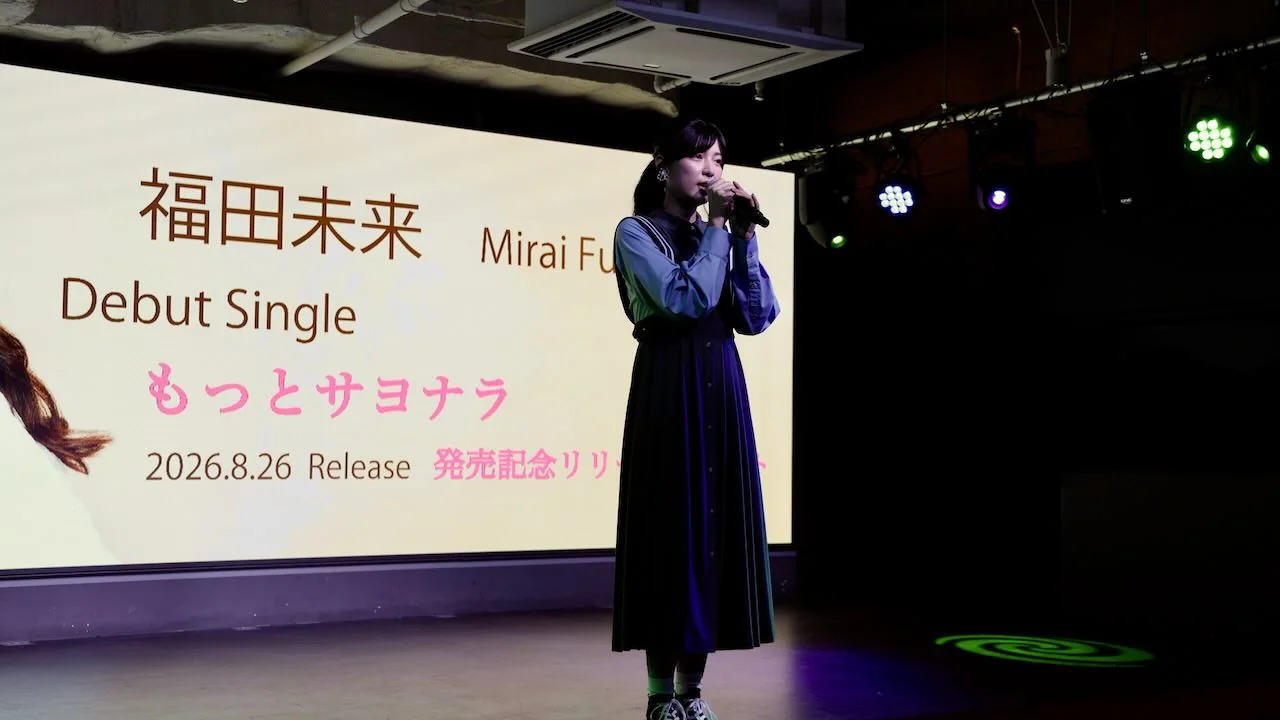
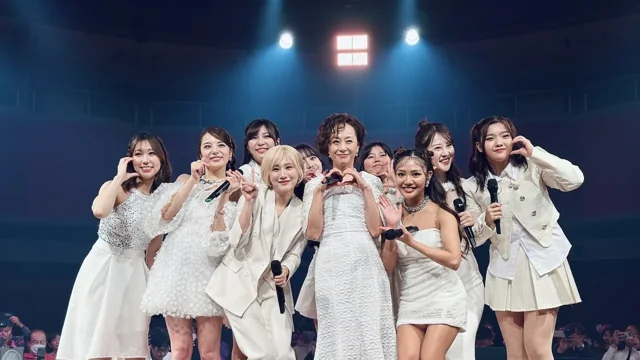
On the evening of August 25, 2026, an audience gathered at MAGNET by SHIBUYA109 in Tokyo’s Shibuya district to see MIRAI FUKUDA. The occasion celebrated her solo major-label debut single, “Motto Sayonara,” due for release the following day, August 26. For fans who discovered her through Trot Girls Japan, it was a moment when the activities following her audition victory came together in a formal record. For those who had followed her much longer, it marked a beginning of another kind. Fukuda had already experienced both group and solo work since her teens. The key phrase for this debut is therefore less “new artist” than “solo major-label debut”: starting again under her own name.
The event consisted of more than a mini concert. Sales of the single CD began at the venue at 5 p.m., before the performance, and buyers received priority-entry numbers and benefit tickets according to the number of copies purchased. One copy granted admission to the post-show handshake session; two entitled buyers to a handshake and a photograph with Fukuda. Before the performance, audience members could also write and submit questions for a Q&A. Buying the record, watching the show, conversing with the artist and finally meeting her in person were connected within a single event.
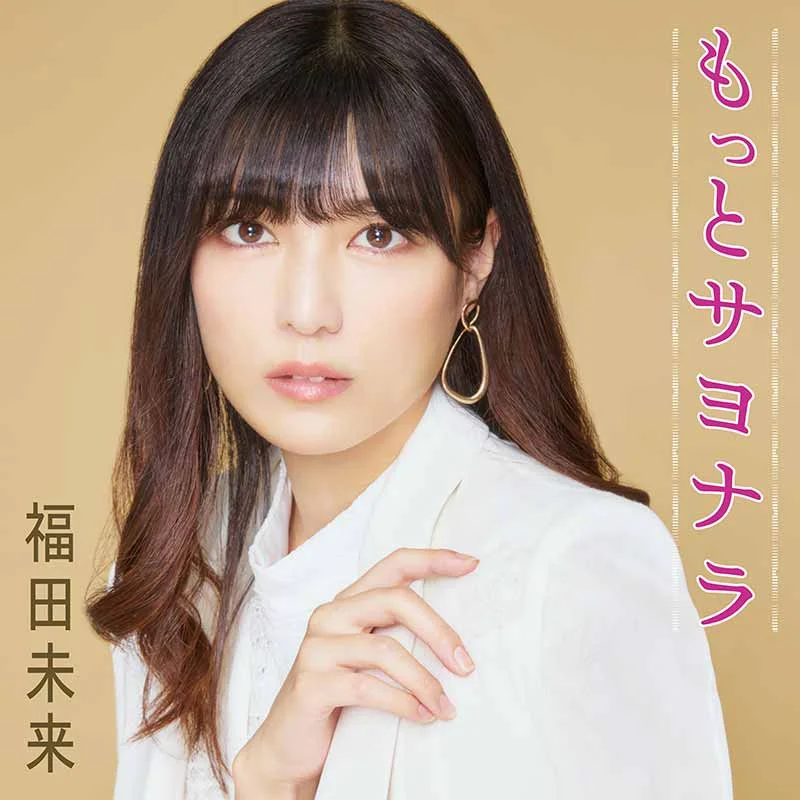
“Motto Sayonara”: the first song chosen by MIRAI FUKUDA at 32
The focus of the performance was naturally the debut single, “Motto Sayonara.” Its title carries a literal nuance along the lines of “more farewells” or “a farewell deeper than farewell,” but the song differs somewhat from a conventional heartbreak song about the moment a relationship ends. Fukuda herself has described it as a song about a parting of the heart that goes deeper than a simple “sayonara” when one must leave someone precious. She approaches it particularly as “adult love” that she can understand and sing precisely because she has reached her present age.
The production credits also suggest the weight placed on this debut. Takahiro Maeda wrote the lyrics, Takao Kisugi composed the music, and Satoshi Takebe arranged and produced it. Teichiku Entertainment describes it as a kayokyoku song retaining a strong late-Showa city-pop coloring while made with a contemporary sensibility. Rather than rushing out a recording to capitalize on an audition winner’s prominence, the debut gives the impression of emphasizing a direction: what music Fukuda will leave under her own name.
Kisugi’s involvement, in particular, connects with Fukuda’s personal musical history. The song she identifies as the first she ever loved is his “Haguresou na Tenshi.” In several interviews, she has recounted her mother’s story that, at around one year old, before she could speak properly, she would listen to it and ask for it again. Decades later, the composer present in her earliest memories of encountering music would write her solo major-label debut song.
The process was not straightforward from the beginning. Fukuda has said that she personally named Kisugi when asked who she wanted to write her debut song, but the actual request initially received a negative response because of scheduling. She nevertheless conveyed how much she had always loved his music and ultimately received a song. She has also recalled being moved almost beyond belief on seeing her name alongside “Takao Kisugi” on a demo file of him singing the melody as “la-la-la.”
That makes “Motto Sayonara” more than simply a debut song. Musical memories beginning with “Haguresou na Tenshi,” heard at around one year old, reconnect with the first solo major-label single of a singer now aged 32. This one song holds the time it took to move from singing music she loved to receiving her own song from the person who created that music.
After Trot Girls Japan: a debut single following a wait
Understanding the single requires looking back to Trot Girls Japan in 2024. Fukuda became the program’s inaugural winner, bringing her name back before audiences in both Korea and Japan. But she did not take the usual route of issuing a solo major-label debut record immediately after winning. She continued moving between broadcasts and performances in both countries, and only in summer 2026, roughly two years later, released a debut single bearing her own name.
Fukuda has said that the people around her were more impatient about this wait than she was. Having once considered giving up singing, she could wait if it meant another opportunity. In the end, that period was more than an empty interval. Receiving a song from Kisugi, a figure at her musical roots, and taking her first step with a work involving Maeda and Takebe made the result closer to choosing what to leave as her first song than simply issuing a debut quickly.
Fukuda’s career also distinguishes this debut from a typical newcomer’s start. She had already experienced major-label stages in a group and spent many years performing through solo work, auditions and appearances across Korea and Japan. Yet her solo major-label debut single under her own name has only now arrived. It suits the present Fukuda that “Motto Sayonara” centers mature feelings about accepting a relationship that must end rather than the excitement of young love. Her own statement that she could not have sung it in her twenties likewise reflects how her long career connects with her interpretation of the song.
Two songs pointing in different directions
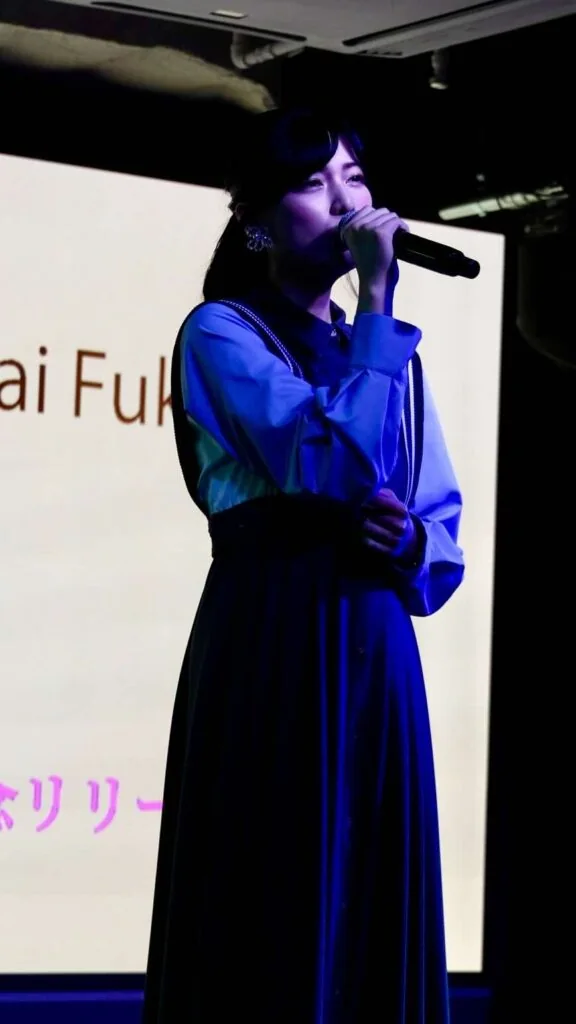
The single includes “Hidamari 2026” alongside the title track. As with “Motto Sayonara,” the lyrics are by Takahiro Maeda, but Toshiyuki Omori composed and arranged it. Although they share one single, the two songs present Fukuda’s voice in musically different ways.
Interestingly, the lyrics of “Hidamari 2026” were not originally written with their present form in mind. Fukuda explained in an interview that they had initially been intended for “Motto Sayonara.” They subsequently developed into a separate song, with Omori’s melody and arrangement giving the work a different atmosphere. Fukuda said that, in contrast with the dark lyrics, the arrangement gave her a feeling like dawn arriving.
The interpretation of the lyrics is interesting too. On the surface they sound like a relationship between “you” and “me,” but lyricist Maeda reportedly suggested listening with “peace” substituted for “you.” That approach considerably broadens the scope of what appeared to be a personal relationship song. If “Motto Sayonara” examines mature feelings arising at the end of a relationship, “Hidamari 2026” opens onto a broader emotion of waiting for something in the darkness.
Pairing these songs suggests that Fukuda places more weight on interpreting kayokyoku in her own voice than on confining herself to a single genre. Her Trot Girls Japan victory may lead Korean audiences to associate her first with trot, but the direction of her first solo major-label single is closer to carrying the lineage of late-Showa city pop and kayokyoku into the present. What matters is that she made her first work within the Japanese popular-song tradition she had long loved, rather than repeating the genre image of the audition program.
A brief mini concert and close-range communication
The event at MAGNET combined a mini concert presenting the new songs with time for direct communication with the audience. Before the show, visitors could write questions on the paper provided and submit them. During the live performance, Fukuda selected some herself and answered them in a Q&A. Time constraints limited the number, but this was more than a showcase of predetermined performances and remarks: audience questions became part of the actual proceedings.
The distance narrowed further after the performance. Benefit sessions for CD buyers included handshakes and two-person photographs, allowing audience members to speak directly with Fukuda, however briefly. Moving from hearing the new songs at a mini concert to the Q&A and benefit sessions expanded a record release beyond a product launch into an experience of artist and fans meeting in person.
Buying a CD and immediately hearing its songs
Even in an era when streaming dominates music consumption, CD release events remain important points of contact with fans in Japan’s music market. This event showed that structure in concentrated form. Audience members bought the new single before the concert, heard its central song performed live by the singer shortly afterward, and met the artist directly once the show ended. Record purchase, live experience and direct fan contact became one continuous sequence within a few hours.
Viewed simply as selling one CD, it is difficult to call this an efficient method of music distribution in the streaming era. But a CD sold at a release event is more than a physical product containing music files. Priority admission, the performance, a handshake, a two-person photograph and a few words with the artist become combined with the purchase, making the record itself function like a participation pass. For fans, this makes release day an event they can remember personally, rather than merely the day a new song appears on a smartphone.
Such events are particularly meaningful for a singer like Fukuda, who already has a fan base while beginning a new solo career. Existing fans gain a memory of directly joining a new beginning, while audiences arriving through recent broadcasts or performances have an opportunity to deepen their relationship with the singer. This fan business operates on a different level from the profitability of a large concert, but it still plays a strong role in developing core fans who repeatedly attend shows and buy records over the long term.
A new beginning for a singer who wants to leave a lasting song
Ahead of this debut, Fukuda described her dream as leaving a great song during her lifetime. Countless new songs already arrive every week, and on streaming platforms new music is continually displaced by the next track. In such an age, speaking of a lasting great song rather than a hit may sound like a rather old-fashioned value. Yet the production team and musical direction chosen for her first solo major-label work show that the words are more than rhetoric.
She received her first song from Takao Kisugi, composer of “Haguresou na Tenshi,” which she had loved since she was one, and completed the work with musicians who have long shaped Japanese popular music. At the same time, she did not abandon the connection with Korea established after Trot Girls Japan. Rather than merely recreating Japanese popular songs of the past, she now stands in a position to connect that music with her present career and deliver it to audiences newly gained in both countries.
The small Shibuya release event therefore cannot be judged by size alone. It was a modest gathering of a few live songs, a short Q&A, handshakes and photographs, but at its center stood the first major-label single under the name of a singer who had kept singing for many years. Both the title of Trot Girls Japan winner and her previous group career were becoming background to a new beginning.
The title “Motto Sayonara” speaks of parting. For Fukuda in August 2026, however, the song paradoxically means a new start. Memories beginning with the first song she loved at one year old, stage experience dating to her teens, a time when she considered giving up singing, a renewed chance through an audition and the past two years of working across Korea and Japan all met at one point.
What began on that small Shibuya stage was therefore more than promotion for a single record. It was closer to the first scene in which a singer who had long loved and sung other people’s great songs declared her wish to create a lasting song under her own name. With a song whose title says farewell, MIRAI FUKUDA’s solo major-label debut was beginning again in that way.
From release eve to the stages after release
The August 25 and September 5 performances document different moments while centering the same single. Reading the first encounter before release alongside the selections from two subsequent shows lets us follow the process of a song reaching its audience.
Read the review of MIRAI FUKUDA’s September 5 release event →
Related sources

MIRAI FUKUDA’s “Motto Sayonara”: two stages shaped by the same new single
Trot Girls Japan’s First Japanese Concert: From Television to the Stage

natsuco, MAKOTO. and MIRAI FUKUDA: Three Voices in “Stay With Me”

KANO MIYU and MIRAI FUKUDA’s “Heavy Rotation”: Reinterpreting Idol Pop

Trot Girls Japan’s “Come Back to Busan Port” Encore: Why Return to the Stage?