REVIEW · Festivals
KANO MIYU’s Seven Songs Connect a Kitakyushu Summer
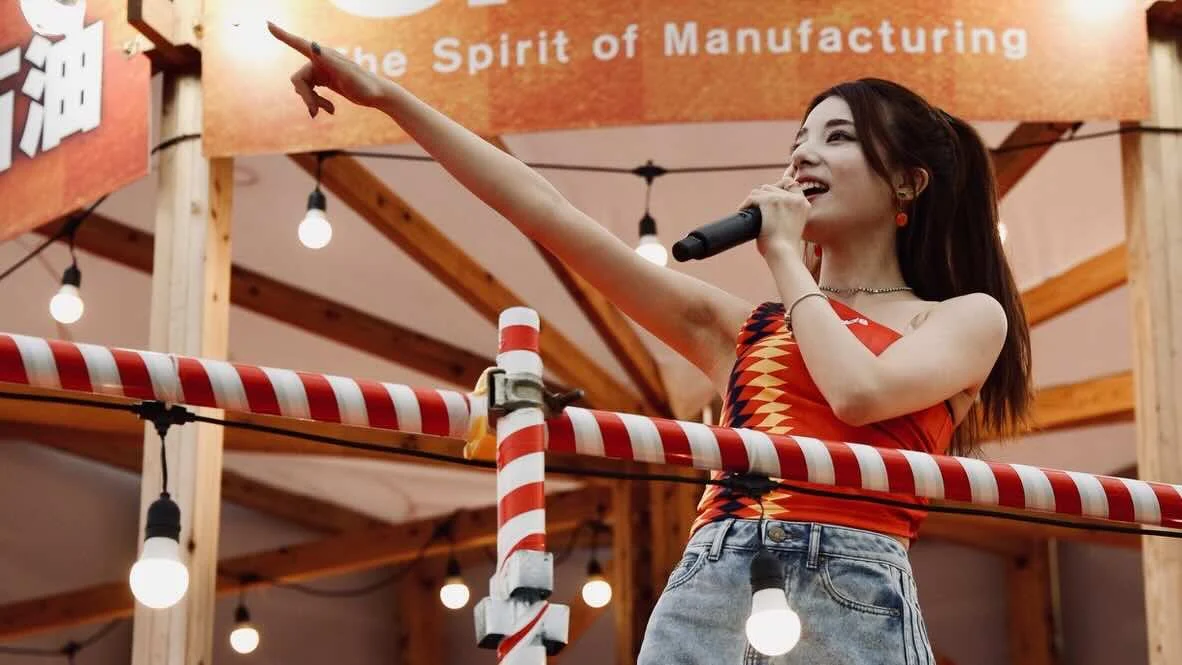
Kitakyushu Showa Summer Festival
Performance order
- OVER DRIVE▶ Watch video
- Ai no Battery▶ Watch video
- Furare Kibun de Rock’n’Roll▶ Watch video
- Watashi ga Obasan ni Natte mo▶ Watch video
- Aoi Sangoshou▶ Watch video
- DO IT NOW▶ Watch video
- Makenaide▶ Watch video
On August 15, 2026, KANO MIYU performed at the Kitakyushu Showa Summer Festival in Katsuyama Park, Kitakyushu, Fukuoka Prefecture. Old Showa songs, bon dancing, countless lanterns and a large yagura tower created a midsummer evening scene. Rather than a venue exclusively for a singer’s fans, it naturally mixed residents, tourists and families. Dedicated spectators shared the space with people who encountered the show while enjoying the festival, unlike a solo concert with an established fandom. The task was not merely repeating familiar songs for supporters, but leaving newcomers with an impression of the singer in a short time.
In that sense, the stage offered an interesting test. Introduced as a singer-songwriter from Omuta working across Korea and Japan, she began at 6:30 p.m. with “OVER DRIVE.” “Ai no Battery,” “Furare Kibun de Rock’n’Roll,” “Watashi ga Obasan ni Natte mo,” “Aoi Sangoshou,” her original “DO IT NOW” and ZARD’s “Makenaide” followed: seven songs in total. Respecting the Showa-song theme while including Korean activities and present-day originals, it compressed her current path rather than simply offering nostalgic covers.
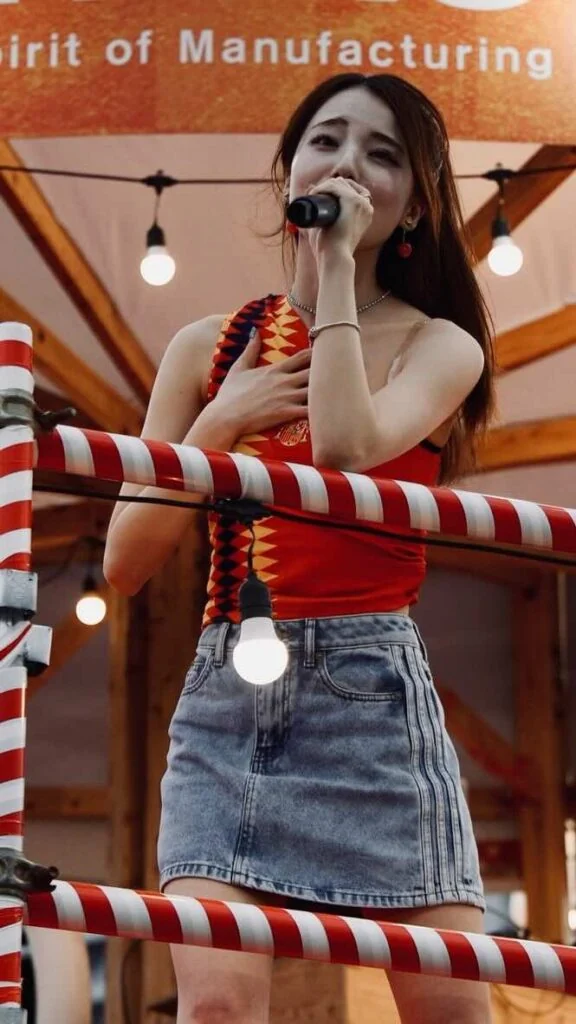
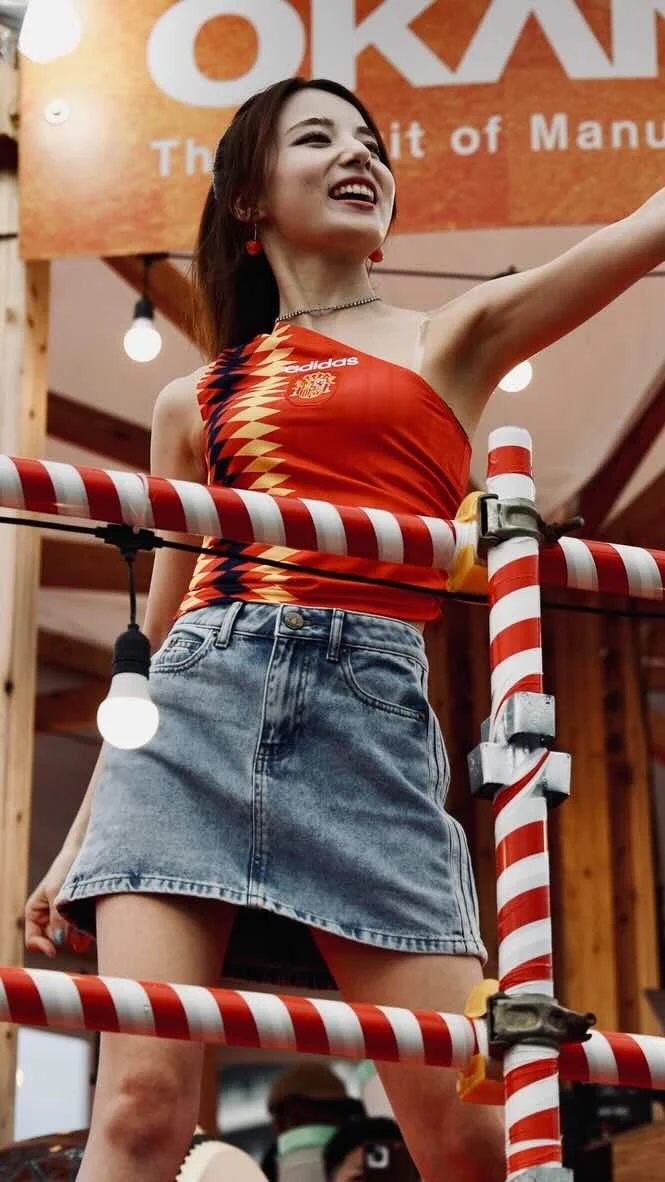
Between the television-known singer and the present songwriter
“OVER DRIVE” was an appropriate opening. Widely known through JUDY AND MARY, it has special significance in her career as one of the audition performances that brought her name and vocals to a broader public on Trot Girls Japan. Given her recent expansion through originals and sis activities, hearing it again seemed less a repeat of a popular cover than a connection between first recognition and her present.
Following with Korean trot song “Ai no Battery” also showed her current sphere. A Korean song within a specifically Showa-themed Japanese festival, followed by older Japanese music, naturally overlapped her cross-border career. Rather than selecting only old Japanese songs matching the theme, inserting repertoire familiar through Korean work placed her current position onstage beyond being a good Showa singer.
Her first live performance of “Furare Kibun de Rock’n’Roll” lifted the atmosphere before the middle. TOM★CAT’s 1984 song, with its strong rhythm and immediate drive, suited the outdoor space. Maintaining its brisk character, she added a bright, clear tone. An unfamiliar selection among established repertoire maintained tension. Covers involve not only resemblance but the new impression possible when a song enters one’s voice; the third song showed that possibility.
“Watashi ga Obasan ni Natte mo” and “Aoi Sangoshou” brought the performance closer to the festival’s original character. Already sung on television and elsewhere, they had a different role here. Familiar to fans, their bright energy gave first-time local spectators an accessible introduction to her character. Direct melodies and clear choruses associated with Showa popular music offered material for drawing even unfamiliar listeners into the show.
“Miyu-chan!”: a small agreement between stage and audience
The striking aspect of “Aoi Sangoshou” was the exchange rather than merely the finished song. Fans following several shows have established a small convention of shouting “Miyu-chan!” at a particular point. As it approached, she cupped her ear to solicit the response. The audience immediately called her name; natural expressions and movement followed as though she had been waiting for it.
These moments matter in her live work. Completing a song accurately and drawing people into it are different skills, often linked here through gestures and brief responses. Repetition creates a familiar participation language for existing fans and immediately shows newcomers how the audience enjoys the show. Such simple interaction is particularly effective at regional festivals where not everyone knows the singer’s music and conventions.
A strength is that this does not separate into overly deliberate fan service. She waits, enjoys the response and returns to singing. The rhythm of briefly dissolving the boundary and returning to the song is natural. Although repeatedly covered, “Aoi Sangoshou” is not experienced identically each time. Small variations and immediate reactions help familiar repertoire stay alive.
“DO IT NOW” amid Showa songs
“DO IT NOW” was the set’s crucial turn. Where earlier songs interpreted others’ music, the center returned to her present. A Showa-themed event is no reason to hide originals. Opening ears with familiar songs before presenting one’s own can effectively introduce music to new spectators.
The song suits that position. Its energy has a clear direction from the start and does not easily sag outdoors. Without entirely breaking from the earlier bright, immediate melodies, it directly demonstrates a songwriter singing her own material rather than only interpreting past hits. The set is not a musical chronology, but its movement from television-known covers toward originals connected with her current direction.
This matters especially in understanding her present. Broadcast covers greatly aided recognition, and interpreting familiar classics in her tone was a strength in Korea too. Yet original music ultimately leaves an artist’s name long-term. Including it naturally at festivals is not simply a question of reducing covers, but of transferring established familiarity toward her own work.
The final “Makenaide” closed that flow smoothly. ZARD’s bright, forward-looking signature song suited a summer finale and had already generated meaningful responses during her television work. Returning live after some time, it reunited the audience through familiarity rather than abruptly cutting “DO IT NOW”’s energy. Following an expression of identity with a widely known encouragement song was a dependable ending for fans and newcomers together.
Another assessment begins after the seven songs
Applause alone cannot measure a regional stage’s outcome. Where many discover it by chance, subsequent actions can be more direct indicators. Here the interesting part came after the finale. People gathered at merchandise sales, lining up for CDs, T-shirts, cheki instant photographs and photo albums. Interest sustained sales for about thirty minutes.
Existing fans and first-time viewers cannot be distinguished precisely, so purchases cannot all be attributed to new fan acquisition. Still, people moving to inspect merchandise immediately after a non-solo festival show demonstrated more than one-off viewing. Moving beyond remembering a name to examining and buying recordings or goods creates at least a minimal opening toward another relationship.
Her presence signing items and speaking briefly at the booth strengthened that flow. Festivals allow people discovering a singer onstage to meet her immediately afterward. Someone tens of meters away becomes a person signing and speaking directly at sales. This distinguishes small concerts and festivals from large shows. Fewer people are reached at once than through mass media, but interest can become a much denser experience quickly.
Alongside exchanges with existing fans, people who watched and then gathered to purchase naturally continued the movement. Time prevented long conversations with everyone, but buying, signing and brief conversation worked as a package. This matters for fandom business: interested spectators can immediately experience music, products and the person without waiting to search or encounter more content.
Singing Showa, but heading toward the present
The festival’s name suggests past Japanese popular music as the center. Indeed, “Furare Kibun de Rock’n’Roll,” “Watashi ga Obasan ni Natte mo,” “Aoi Sangoshou” and “Makenaide,” remembered across generations, anchored the set. She respected the required atmosphere and prepared enough accessible songs for residents.
But all seven did not remain in the past. “OVER DRIVE” held the beginning of recognition, “Ai no Battery” her present cross-border route, and “DO IT NOW” her current songwriting self. Through the final “Makenaide,” the television-known singer and the performer growing in venues, the cover vocalist and the creator expanding her repertoire, crossed within one stage.
This matters because festivals are not solely for existing fans. Familiar songs open doors for newcomers, while added repertoire and originals show changes to supporters. Two audiences can watch for different reasons simultaneously. The show demonstrated that balance relatively clearly.
Its effect did not vanish with the last note. People remained at sales; signatures and conversations extended interest into another experience. This may be the small festival stage’s most practical value. Alongside exposing a name to thousands, motivating a few accidental listeners to seek the singer afterward can also begin fandom expansion.
She showed more than an ability to reproduce Showa songs. She approached new spectators through familiar music, placed her present within it and continued relationships afterward at person-to-person distance. A summer festival of Showa songs revealed, rather, where she is going now.
Related event footage
Related event footage from Diego’s channel.
View all videos · 7
KANO MIYU changes the mood from afternoon to evening — Hanno Music Festival 2026

KANO MIYU returns to Fukuoka through song — Daikoku Festival 2026
KANO MIYU and SIS at the crossroads of Kuro Fes 2026

sis in Atami, Part 2: Evening Falls on the Same Stage
sis in Atami, Part 1: Thirty Minutes Between the Sea and Summer Light