REVIEW · Fan Meetings & Signings
KANO MIYU in Shibuya: A Fan Meeting Between Songs and Conversation

Session one · Acoustic
Performance order
- Futari no Sekai
- Re:Road
Session two · Song segment
Performance order
- Good Day
- Over Drive
- Plastic Love — with Natsuko
An intimate fan meeting at Shibuya’s Manekineko
Japanese vocalist KANO MIYU held a fan meeting in Shibuya, Tokyo, on March 7. The event took place in Hall 1 at the Manekineko karaoke venue, an intimate room with approximately 50 seats, bringing fans close to the performer. It was split into a noon session and a 3 p.m. session, both designed around direct interaction with fans.
Doors were scheduled to open thirty minutes before each session, but admission took longer than expected and the performance did not begin on time. Despite the small capacity, ticket checks and seating guidance pushed the schedule back. Checking tickets while also explaining purchase benefits appeared to contribute to the delay.
The room resembled an event space inside a karaoke building more than a conventional live club. Around fifty seats faced a small stage, with very little distance between audience and performer. Rather than the elaborate staging or sound-led presentation of a large venue, it suited a gathering built around conversation and songs. The event itself alternated between chat, activities and music.
Session one: a program built around conversation
Conversation with fans led the first session. Early on, a Q&A segment used questions written in advance. Instructions about submitting questions had been insufficient, however, and prolonged admission left relatively few. As a result, almost all those submitted were read out.
Fans with later entry numbers had particularly little time to write, an unfortunate consequence of the slow admission process. On the other hand, the smaller number of questions meant nearly every submitted one could be addressed.
Next came a conversation around photographs. Recent snapshots prompted stories from daily life, with several ice-cream pictures naturally turning the conversation in that direction. Travel and everyday photographs kept the discussion light and helped establish the relaxed atmosphere of a fan meeting.
Giving presents to fans
A gift draw followed, using entry numbers. Paper slips bearing the numbers assigned at ticket purchase were placed in a box; MIYU drew them to select winners. Those whose numbers were called received a notebook signed by KANO MIYU. The gifts were handed directly to the winning fans.
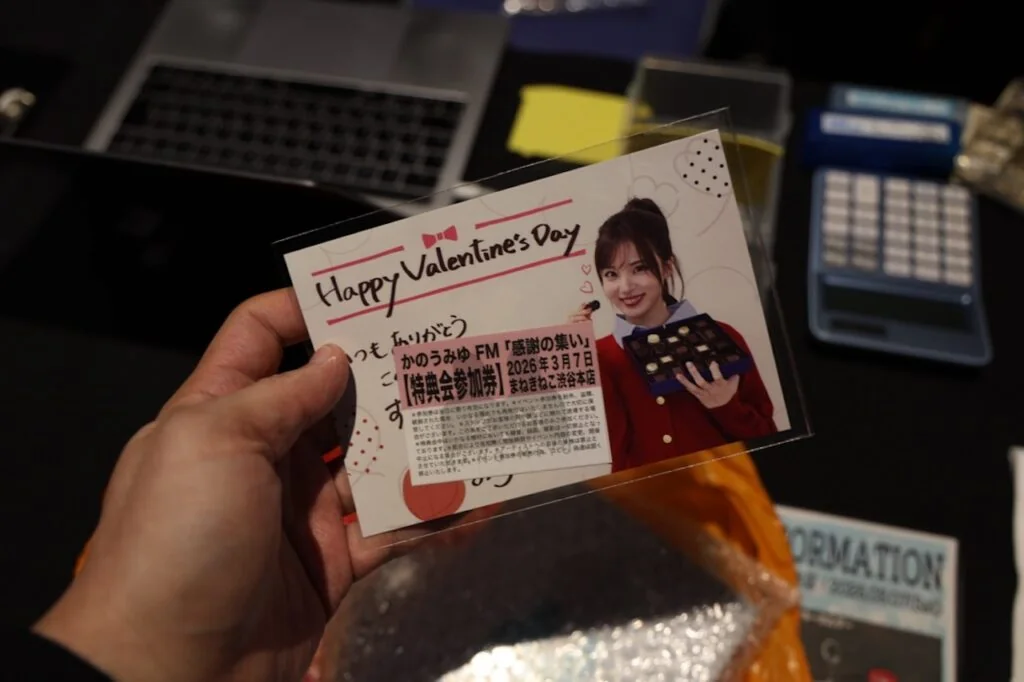
MIYU had also prepared small snack gifts. These were boxes containing chocolates and other treats, apparently with slightly different assortments. Rather than identical contents, the mix varied according to which box a fan received.
The small gathering gave even this simple activity an intimate feel. More than an isolated game, it reflected the occasion’s purpose of meeting fans directly.

An acoustic performance
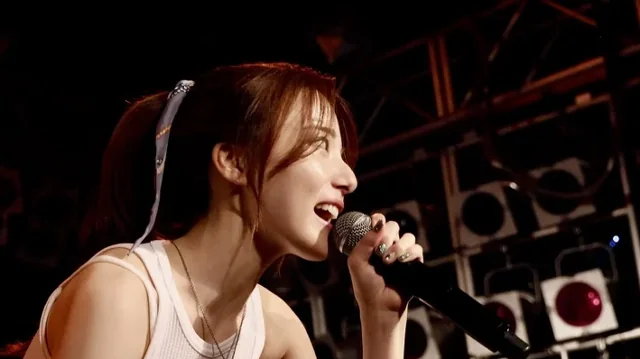
Later in session one came singing with her own guitar accompaniment. The selections were “Futari no Sekai” and “Re:Road.” These two songs created a calm atmosphere, even within a karaoke venue.
It felt different from a concert in a large hall. With so little space separating artist and listeners, the moment resembled sharing music in a small room. Performance and conversation blended naturally in the fan meeting format.
Session one ended with a purchase-benefit meet-and-greet. For fans who had bought the album beforehand, the activities included autographs, two-person photographs and TikTok filming. Participation was not extended to every purchaser: only selected fans chosen by a random draw could take part. That lottery determined access to the benefits.
Session two: more questions in the Q&A
The second session followed a similar structure, but the number of questions increased considerably. There was no longer time to cover them all, so a selection was answered.
Everyday subjects continued. Asked how she spends time at home, MIYU said she often eats while watching Korean dramas, naturally revealing her interest in Korean entertainment.
Her favorite ice cream was vanilla in a cone. She explained that simple, white vanilla ice cream was her preference. Favorite Korean foods included meat dishes such as samgyeopsal and bossam, respectively grilled pork belly and boiled pork served in wraps.
Asked about eating before a show, she said she tended not to eat the day before or on the morning of a performance. She often ate afterward instead, describing this as part of her routine for preparing her condition for the stage.
Another question concerned milk. She explained that milk does not agree with her, so she generally drinks soy milk instead. This was another glimpse into her daily habits.
There was a small interruption during the Q&A. A Korean fan submitted a question in Korean, which MIYU tried to read but did not immediately understand. Host Natsuko did not understand Korean either, briefly pausing the proceedings.
MIYU solved the problem by taking the sheet toward the audience and asking a Korean fan to explain it directly. After a short explanation, the question was understood and she answered. It was an unpolished, natural exchange characteristic of a gathering like this.
Making use of the karaoke equipment
Session two included a segment using the karaoke system. The venue’s location inside a karaoke building made this a natural addition. It also marked the clearest change of atmosphere from the first session.
The selections included IU’s “Good Day”, Over Drive, followed by one of Japanese city pop’s best-known songs, “Plastic Love.” The closing selection, “Plastic Love,” became a duet with host Natsuko. The mood was informal and shared with fans, more a participatory event than a formal recital. It helped make the second session brighter overall.
After karaoke, the program returned to guitar-accompanied singing. The songs this time were BOL4’s “You (=I)” and and “TERMINAL.” Coming near the end, the acoustic set restored a calmer mood. Where karaoke had lifted the energy, guitar and voice drew the program back together.
Closing with the purchase-benefit activities
The photographs and benefit session proceeded through autographs, two-person photos and TikTok filming, in that order. Not everyone participated in identical activities. Eligibility was decided by a random draw for fans who had bought the album in advance. Fans purchased beforehand and learned through the onsite draw which benefit they could join, creating anticipation about the result. Autographs and two-person pictures were familiar offerings; the inclusion of TikTok filming stood out.
The closing opportunities to meet MIYU proceeded at a relatively relaxed pace overall. Staffing largely appeared to consist of part-time personnel rather than specialist event staff, and the resulting flow was slower than one might expect.
What stood out most was how different the atmosphere felt from earlier events. At previous benefit sessions, photographs and autographs often moved rapidly into the next turn. Staff frequently interrupted when a fan tried to add another word. That approach had recurred because the entire event had to keep moving to schedule.
The difficulty was that fans had often found the experience unsatisfying. These sessions can be one of their few chances to face the singer directly, yet the encounter was frequently over almost immediately. Being photographed and then moved along could feel perfunctory. Beyond the short duration, the structure itself allowed almost no room for conversation, which was a recurring disappointment.
This gathering felt different. Brief greetings and a few words arose naturally after photographs, and fans seemed more comfortable continuing a conversation. The small scale probably helped, but the key difference was that it felt like a real opportunity to say hello rather than a process to hurry through, at least as experienced in the room.
There were still shortcomings. Slow admission delayed the start and affected session one. Inadequate instructions about writing questions were also noted onsite. Although entry was to begin thirty minutes before the show, later-numbered participants were barely seated before it started. Some lacked time to write, leaving the Q&A board sparsely filled. Every submitted question was read because there were so few, but the segment passed more lightly than its intended design suggested.
A small operational error also occurred during the benefits. After one two-person photo, the next participant entered before the preceding fan’s turn had fully ended. Usually there would be a brief goodbye before moving away; here the transition happened before that moment had properly settled.
It did not significantly disrupt the event, but could still feel awkward to the fan involved. After a long wait, a few seconds for a final greeting can matter more than expected. An extra beat from staff would have made the ending smoother.
Even so, the benefits were generally less hurried than at earlier events. They felt more like a chance to greet the artist directly than a procedure to complete quickly, helping leave a positive impression of the meeting.
An event shaped by proximity
This Tokyo fan meeting had a different purpose from a large concert or showcase. In a room of around fifty seats, conversation and shared music took precedence over elaborate production. The physical distance was short, and the program emphasized exchange rather than performance alone.
Guitar songs, karaoke and questions combined into a relaxed gathering. Rather than a one-way presentation of a prepared show, conversation developed in the room and music followed naturally. Some also felt Natsuko’s presence as host made the atmosphere livelier. Conversation flowed more easily than with a single presenter, and she gently bridged the gaps between songs.
Its scale could not be compared with a major event, but the small room made the closeness more tangible. Flexible segments such as guitar accompaniment and karaoke gave it the feel of an informal musical gathering rather than a conventional concert.
There were several disappointing moments in the operation, but the event concluded relatively smoothly. Above all, it created time to talk directly and share music at close range, making this Tokyo fan meeting meaningful for those present.

KANO MIYU changes the mood from afternoon to evening — Hanno Music Festival 2026

KANO MIYU returns to Fukuoka through song — Daikoku Festival 2026
KANO MIYU and SIS at the crossroads of Kuro Fes 2026

sis in Atami, Part 2: Evening Falls on the Same Stage

sis in Atami, Part 1: Thirty Minutes Between the Sea and Summer Light