FEATURE · 칼럼
After Meeting Kanou Miyu on Change Street, What Should You Listen to Next?

Kanou Miyu’s name appeared among Change Street’s Japanese performers alongside Kumi Koda, Crystal Kay and Takaya Kawasaki. For someone switching on to see a familiar artist, she may be a new name. Audiences who have followed her concerts, by contrast, may wonder what the singer they know from smaller stages and original songs will perform with others this time. The same lineup offers different starting points.
Before asking why the producers selected her, then, it is worth asking where Miyu has sung and what she has written. If someone meeting her name through television can find those performances and songs, the cast list becomes an entrance into an artist’s work. Hearing both her competition covers and songs released under her own name expands the picture beyond a single television scene.
A music program crossing into each other’s streets
Co-produced by ENA and Fuji TV, Change Street commemorates the 60th anniversary of normalized diplomatic relations between Japan and South Korea. Fuji TV’s official introduction describes artists visiting each other’s countries for street performances, alongside experiences of local culture and studio conversations. The place where a song rings out, and the singer’s response to that place, become part of the program.
That is also a reason to anticipate the performances: where will a familiar song be sung, and how will musicians who speak different languages meet? Instead of simply following a contest result, viewers encounter songs alongside street scenes. Still, the show’s stated format should be distinguished from each participant’s actual performance. Which artist feels new depends on the viewer, and memorable scenes are made within the performances themselves.
The official sis website also announced Miyu’s participation on December 17, 2025. The premiere times given then were 9:30 p.m. on December 20 for Korea’s ENA and 26:45 on December 19 in Japanese late-night scheduling—2:45 a.m. on December 20—for Fuji TV. Fuji TV specified a Kanto-region broadcast followed immediately by availability on FOD. The two channels were not scheduled to air it at the same time. Even if audiences learned of the appearance through different outlets, viewers in both countries gained an opportunity to encounter Miyu through the same music program.
A voice heard in competitions, a guitar that came before them
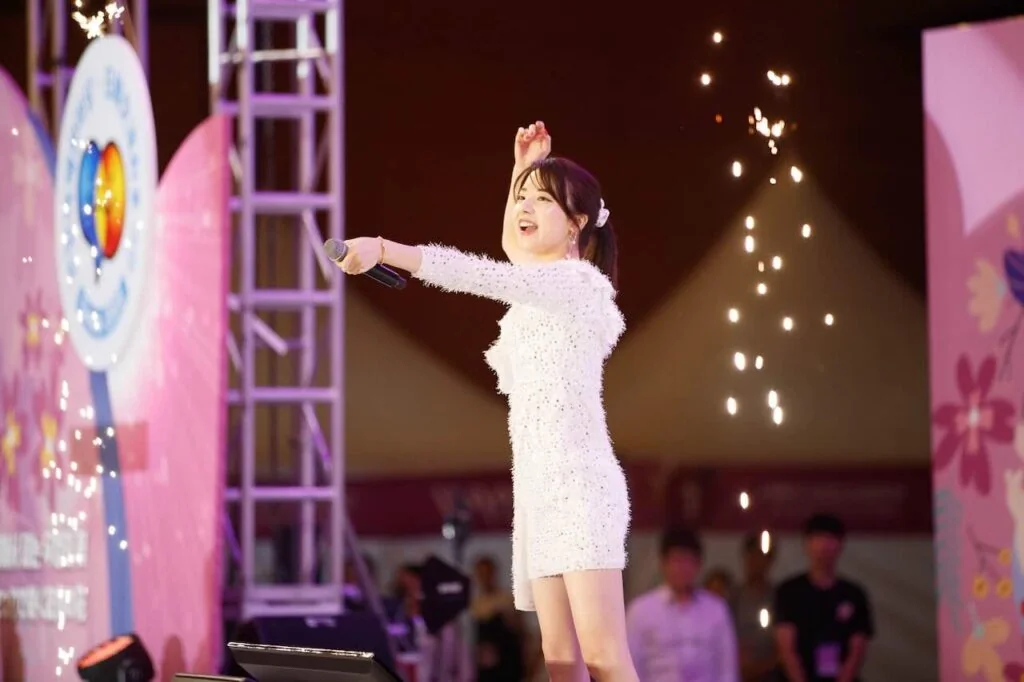
Trot Girls Japan, Korea–Japan King of Singers and Korea–Japan Top Ten Show helped introduce Miyu to Korean viewers. Among the songs associated with those appearances, ‘Over Drive’ is a JUDY AND MARY song. It recurs in introductions to her music, but should be distinguished from her originals. Rediscovering a familiar composition in a particular singer’s voice and hearing that singer’s own writing for the first time offer different pleasures.
Before television, there was time spent singing with a guitar. Her official profile records live performances with her own guitar accompaniment from childhood and consecutive appearances at Music City Tenjin from 2013 through 2019. Describing her only as an audition-show alumna obscures those years. Local live shows and televised competitions are different settings in which the same artist has sung; neither replaces the other.
Holding those two scenes together also makes song selection interesting. In a cover performance, listeners’ memories of the original enter the room. An original brings together audiences familiar with the artist’s other work and people hearing her for the first time. There is no need to rank one as a more truthful expression. Where one song reaches listeners through familiarity, another begins its encounter with them at the first melody.
A path toward the original songs
Miyu’s solo repertoire includes ‘DO IT NOW,’ ‘Akiramenaide,’ ‘Re:Road,’ ‘Terminal’ and ‘Baby Paradise.’ Listening to them together makes it harder to reduce her to one mood. Place lively, forward-moving songs beside ones that linger more slowly, and the breathing of a concert becomes audible in ways a single competition performance cannot convey.
‘DO IT NOW’ and ‘Akiramenaide’ first communicate a sense of forward momentum. ‘Re:Road,’ by contrast, invites attention to an ongoing flow rather than a sudden release of feeling. This difference is better understood as a contrast that lets listeners receive songs at different speeds than as a division into strong and weak tracks. One song may attract you first, but the next can reveal another expression in the same voice.
‘Terminal’ and ‘Baby Paradise’ belong in that listening as well. Rather than explaining a singer’s personality or life through one track, it is more useful to hear what changes when differently titled songs share a performance. Here, too, lies the difference between selecting a track from a recording or video and following a whole concert. Waiting for a favorite can create time to encounter a song you did not yet know.
Interest moving from a television appearance to original songs does not necessarily mean those songs will be performed on the program. A viewer might remember the voice, then find another video on an official channel or hear the song that shares a concert’s title. Miyu’s official activity history lists her 2025 solo shows titled Terminal at both Tokyo’s Harajuku RUIDO and Seoul’s ONMAM THEATER. An interest beginning with a Japanese cast list can therefore lead to concert records in both countries.

Group and solo work: different places to meet the same name
Miyu has continued solo performances alongside her work with sis. Someone encountering her in a group and someone seeking a concert under her own name may arrive with different expectations. One may look forward to voices singing together; another may want to hear more from the singer-songwriter holding a guitar. There is no reason to declare one the authentic self and the other a temporary role. Watching the songs she takes on in each setting adds another scene to the name.
Change Street sits among those scenes. For someone who knows Miyu through competitions, it offers a different television format; for a new viewer, it can prompt a search for earlier performances. One broadcast does not guarantee a change in recognition or musical reputation. What is tangible is an additional route to the songs. What to hear or which concert to seek next follows each viewer’s own interests.
Looking up a venue is itself one way of listening to music. Seeing the same concert title, Terminal, attached to Harajuku RUIDO and Seoul’s ONMAM THEATER invites curiosity about how one artist’s songs continued across two cities. Moving between countries becomes more than a vague description: it points to activity documented in actual tickets and concert records. Television cannot show all that time, but it hands interested viewers names they can follow further.
There is no need to learn many songs by a new artist at once. Beginning with one that stays in the ear is enough. Placing a competition cover beside a solo-concert song lets listeners hear differences for themselves that a brief television appearance could not reveal. That listening time may last longer than someone else’s confident declaration of a singer’s potential.
The songs that remain beyond the lineup
Calling a new participant ‘an artist waiting to be discovered’ is convenient. It need not erase the years already spent singing. Miyu had songs and audiences before joining this program’s lineup. For those meeting her through Change Street, practical guidance on where to begin listening may be more useful than a conclusion that she has already proved her ability.
If a voice stays with you after the broadcast, then, try one more song. Someone introduced through ‘Over Drive’ can turn to her originals; someone who first saw a solo concert can seek a performance with other singers. That is when a name beneath a program title becomes the memory of an actual song. Part of the pleasure of anticipating and revisiting Kanou Miyu’s appearance is knowing there are still unheard songs beside that name.

KANO MIYU changes the mood from afternoon to evening — Hanno Music Festival 2026

KANO MIYU returns to Fukuoka through song — Daikoku Festival 2026

KANO MIYU and SIS at the crossroads of Kuro Fes 2026

sis in Atami, Part 2: Evening Falls on the Same Stage

sis in Atami, Part 1: Thirty Minutes Between the Sea and Summer Light