REVIEW · Broadcast & Video
Namewee’s “Tokyo Bon”: familiar English in another rhythm
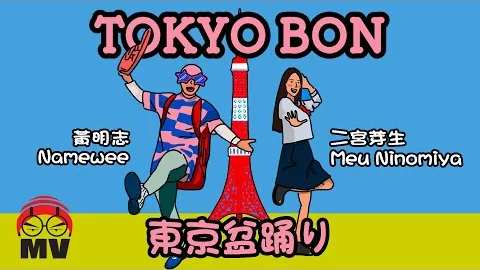
An English word can be familiar and still take a moment to recognise when heard in Japanese. “Tokyo Bon” makes that brief displacement its material. Namewee’s official video title foregrounds Japanglish: the changes a familiar word undergoes in another language’s sound system become an entrance into humour and memory.
The collaboration features Meu Ninomiya and Cool Japan TV. Namewee’s official album page lists it as “Makudonarudo (Tokyo Bon),” the second track on the 2017 album All Eat Asia. The video and album titles point to the same impulse: turning sounds already used in daily life into performance material.
Namewee — Tokyo Bon 2020 feat. Meu Ninomiya & Cool Japan TV | All Eat Asia 2018 (Official Music Video)
A pronunciation that stays before its meaning
The album spelling “Makudonarudo” makes the song’s interest clear. A globally familiar business name gains a more finely divided syllabic shape in Japanese. Someone who knows the source word notices the difference; a Japanese speaker may hear an ordinary pronunciation brought into unusual focus. The same sound makes a different joke depending on the listener’s language.
The pleasure is not confined to misunderstanding. It can arise when we know the meaning but hear the word change length and shape. A spelling to memorise becomes material to repeat and imitate. The song preserves the difference that smooth interpretation might otherwise remove.
A place for a pronunciation joke
Treating Japanese English as comedy also brings a tension. If a pronunciation is heard only as an unsuccessful imitation, the everyday context of its use disappears. A more interesting reading recognises that borrowed words have become an independent part of daily Japanese. Their sounds do not require restoration to English before they can mean something.
Nor does every word in the song need to become a symbol of Japanese culture or a beautiful image of nature. Proper names and loanwords retain distinct contexts. Separating the speed with which the song connects sounds from the things those words actually designate makes this language play more rewarding.
An invitation into the dance
Cool Japan TV describes “Tokyo Bon” as a music video centred on Japanese culture, listing planning, filmmaking, choreography and casting among its work. The title’s reference to Bon dance also identifies a format that offers song and movement together. Imitating a pronunciation and imitating a gesture belong to the same invitation.
Complete verbal understanding need not precede movement. A repeated sound or action can create a place to join in; meaning can be explored afterwards. A traveller’s unfamiliar culture and a resident’s everyday surroundings can enter the same dance. The format supplies a small unit people can repeat together, without requiring the disappearance of cultural differences.
The name beyond the screen
The producer subsequently organised TOKYO BON DANCE FEST 2019 at Kanda Myojin on August 9, 2019. Its official announcement places Bon dancing alongside live performances. A name associated with a video became an event for people to gather and dance, making the project’s direction tangible.
The memorable achievement of “Tokyo Bon” lies in making a pronunciation hard to dislodge from the mind. Short, repeatable sounds and movements call the song back. Participation can begin before a listener fully understands a language. This wordplay draws its strength from that small entrance.
Music and production information
Namewee · Tokyo Bon, official music video ↗ · Namewee · All Eat Asia album record ↗ · Cool Japan TV · TOKYO BON production ↗ · Cool Japan TV · TOKYO BON DANCE FEST 2019 announcement ↗