REVIEW · Songs & Albums
Wink’s “Ai ga Tomaranai”: The Beat of a Love That Will Not Stop
Karaoke song codes
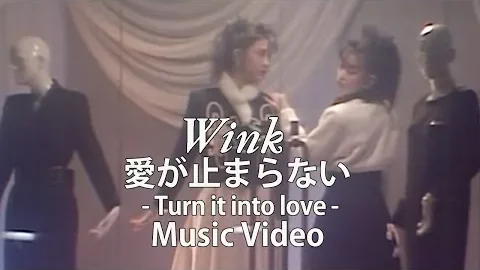
Wink’s “Ai ga Tomaranai — Turn It Into Love” creates an intriguing tension between the two titles printed together. Beside the English invitation to turn something into love sits a Japanese title meaning that love will not stop. One reads like a proposal for action; the other, like words caught in an emotion already underway. Even when a melody is adapted into another language, the entrance into the song can change. Starting from this small shift in language, rather than presenting the song only as a successful adaptation, makes the expression of love more specific.
Wink — Ai ga Tomaranai — Turn It Into Love (Official Music Video)
From “turn it into” to “it will not stop”
The expression “will not stop” suggests a state continuing independently of intention: a moment when one cannot put feelings in order despite wanting to, or is surprised by an emotion’s persistence. There is no need, however, to define the narrator’s relationship as obsession or catastrophe from the title alone. More revealing is the sense that feeling does not move solely at one’s command. The center of a familiar song shifts slightly when love is expressed in the language of continuation rather than choice. The title opens that difference concisely.
The dance rhythm’s repetition lets the body follow that continuation. The words about an unstoppable heart and the continually moving beat flow in one direction. Being able to move joyfully, however, does not make emotion simple. While the rhythm advances, the mind may circle the same place. Movement and stasis heard together create the song’s tension. Attending to which feelings remain in the repeated pulse suits it better than descriptions such as fast or dazzling.
A beat moving forward and a heart held in place
Judging a cover solely by its faithfulness to the original misses expressions arising from a change of language. Wink’s version offers the pleasure of recognizing a familiar melody alongside the experience of that melody carrying different sentences. There is no reason to rate either the original or the adaptation as deeper or more mature. Even the same musical flow can change the story listeners anticipate depending on the words it encounters. The difference can be found in the narrator’s attitude toward feeling rather than in musical superiority.
Two people singing together also bring another impression to the convention of a single person’s confession. Sharing the same emotion makes it both a private inner feeling and an expression maintained together. Explaining that as a limitation of idol pop would instead narrow the form’s possibilities. A song’s emotional depth does not depend only on how directly it discloses one person’s private life. It is worth hearing how several voices and a carefully arranged performance can still convey a heart that is difficult to control.
A different expression created by adaptation
The repetitions in “Ai ga Tomaranai” do not readily confirm that the emotion has ended. The experience of the chorus and beat continuing in the mind after the song finishes overlaps with the title. A sound remembered as easy to dance to can also be heard as a form expressing emotional persistence. On another listen, try comparing the directions of the two titles while singing along to the familiar melody. Between words proposing to turn something into love and words observing a love that already will not stop lies the particular space occupied by Wink’s version.