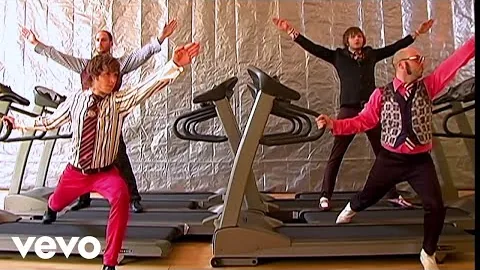
REVIEW · Broadcast & Video
OK Go’s “This Too Shall Pass”: waiting for the next link
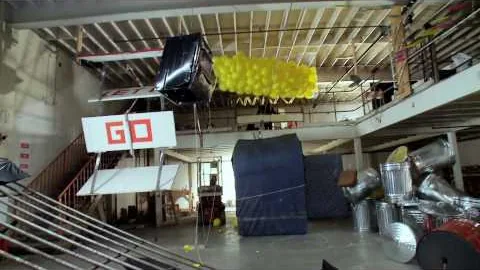
The fascinating question in OK Go’s “This Too Shall Pass” is how we follow the machine’s complexity. One movement triggers another, carrying our attention forward until the song ends. An event has already passed, but the force it released is travelling through another object.
OK Go Sandbox, the band’s official educational project, describes a series of simple machines connected into a chain reaction timed to the song. At one point the machine plays part of the music itself. Objects make musical timing visible, while the song gives us a measure of how long to wait for them.
OK Go - This Too Shall Pass - Rube Goldberg Machine - Official Video
Watching for what comes next
A chain reaction invites a succession of small predictions. Where will that movement lead? When will the next object respond? We need not understand the whole machine at once. Following the event before us brings the next one into view. These brief intervals of anticipation make a complicated construction watchable.
That anticipation overlaps with the song’s own duration. A music video often changes scenes to follow musical accents; here, the movement of an object prepares the next scene. A new event occupies the place where the previous one ends. As the song proceeds, the screen accumulates an order that cannot easily be reversed. A chain reaction is an apt visual form for that passage.
When a prop joins the performance
The tuned glasses discussed in the official resources make the relationship especially direct. The mechanism enters the process of producing notes. When an ordinary household object takes the place of an instrument, what happens on screen moves closer to what reaches our ears.
There is no need to hear every object as an instrument. Some pass movement along; others produce sound. Their different functions share a timetable. This encourages us to notice the connections before and after an object, rather than simply its size or spectacle.
The repetition behind the finished sequence
OK Go Sandbox’s production resource describes collaboration with engineers, extensive testing and repeated attempts to capture the sequence. The finished video’s apparent ease rests on that repetition. The more independently the objects seem to move, the further the people who aligned their timing recede behind the image.
Fitting separately made sections into one song requires connections before and after each. What a section passes onwards matters as much as its individual appeal. Even a striking device becomes part of the whole when someone else’s work receives its movement.
Another version, carried by people
The song also has a separate live video featuring the Notre Dame marching band. In a January 2010 official post, OK Go described it as filmed live. Placed beside the machine version, it offers a different way for many participants to make one song together.
In one version, objects hand movement to other objects. In the marching band version, performers share the song’s time. Comparing them need not become a contest of spectacle. Together they show how many connections keep a song moving, and how differently those connections can be made visible.
Music and production information
OK Go Sandbox · This Too Shall Pass video guide ↗ · OK Go Sandbox · Making This Too Shall Pass ↗ · OK Go · Notre Dame marching band video announcement ↗