FEATURE · 칼럼
Hisashi Mitsui in Slam Dunk: Failure, Recovery and Starting Again
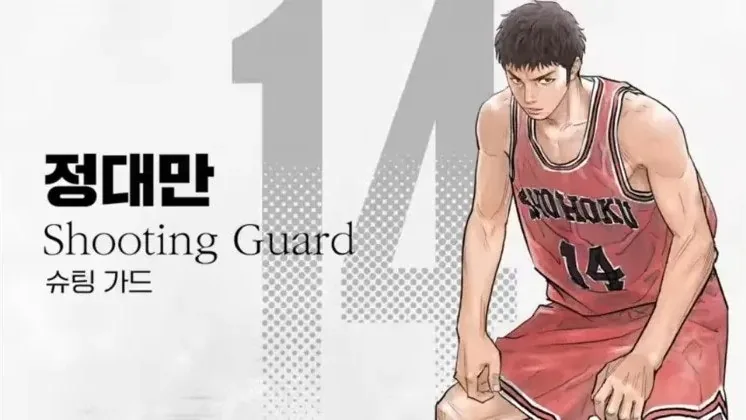
— Why Hisashi Mitsui remains one of Slam Dunk’s most beloved characters
Slam Dunk has a large cast: a prodigiously gifted protagonist, players whose natural physical ability overwhelms opponents, and others who push beyond their limits through effort and diligence. Yet surprisingly few characters keep being mentioned as the years pass and remain beloved across generations. Hisashi Mitsui is consistently near the top of that list.
It is not difficult to understand why. Mitsui is neither the story’s most complete player nor its most dependable person. He has failed, drifted and already lost his way once. Even so, we find it hard to let him go. The reason is more than simply that he is cool. Mitsui has passed with unusual honesty through a stretch of life we would often rather avoid facing.
An early talent, an early collapse
Mitsui was an MVP in junior high school. He has already experienced reaching the top, a crucial detail in understanding his character. He is not someone who became discouraged because he lacked talent. He had talent and knew it, which makes his collapse all the more severe.
His injury after entering high school is more than a sporting setback. It destabilizes the identity he has established through basketball. Rehabilitation and the path back take longer than expected, and he gradually drifts away from both the team and the sport. What fills that absence is not growth but a loss of direction.
At this point, Mitsui departs from a familiar sports-manga formula. In many stories, injury leads directly to a narrative of overcoming adversity. Mitsui cannot manage that. He runs away, goes off course, falls in with delinquents and lets time slip by without knowing where he is headed. The premise is uncomfortably realistic. Though he is a manga character, he has a strikingly recognizable human face.
Choosing to return when it already feels late
Mitsui’s return is moving, but it is also cruel. He rejoins the basketball club in his final year of high school. Much time has already passed, and nobody can make up the lost interval for him. His stamina is depleted, his instincts are rusty, and his classmates have already established rhythms of their own.
The crucial point is that Mitsui does not return certain that things will work out again. Success is not guaranteed. He comes back with only the desire to play basketball once more and the realization that he no longer wants to run away. That choice is what makes him special.
People often decide not to begin at all once they feel it is too late. Mitsui does something different. Knowing better than anyone how late it is, he steps onto the court anyway. Before it is an approach to sport, this is an approach to life.
Beyond the image of the man on fire
Mitsui is often associated with a fiery nickname—the man on fire. There are the three-pointers at crucial moments and the explosive ability to turn a game’s momentum around. Those scenes are undeniably powerful. Yet his real appeal does not lie in the explosion itself.
He is always fighting the limits of his stamina. He runs out of breath, his legs grow heavy, and he physically feels how different he is from his former self. Still, he refuses to give up. He prepares for one more shot and waits for the next opening. When he is truly needed, he shoots as though squeezing out his last reserve of strength.
The sight moves us because this is not talent exercised with strength to spare. Mitsui’s game is always driven by an urgent need. His shot therefore feels like more than a score: it is a declaration that he is not finished yet.
Why we really love Mitsui
Character analysis alone can explain only so much of Mitsui’s enduring appeal. What ultimately makes him special is that we recognize ourselves in him.
Most people lose sight of a goal at least once. We head in the wrong direction or spend time in ways we later regret. Then we use that lost time to decide that it is already too late. Mitsui is someone who starts again at precisely that point.
He does not romanticize his past. He blames himself, feels regret and looks directly at his own idleness. But he does not stop there. Acknowledging that he is late, he takes another step. That attitude resonates deeply with many readers.
What it means to refuse to give up
Mitsui never recovers completely. He does not become a player who controls every game. Instead, he stays. He tries to remain on the court to the end and do what he can when the moment calls for him.
His story is therefore less a tale of success than a record of recovery. That recovery does not happen in one decisive moment. It is a repeated sequence of losing his breath, struggling and shooting again anyway.
Perhaps that explains why we often like Mitsui more when we reread Slam Dunk as we grow older than when we first encountered it. He represents not growth, but the possibility of starting again.
Mitsui tells us that lost time does not make the choices we make now meaningless. Even someone who begins late can eventually have a story of their own if they stay to the end. That is why we still love Hisashi Mitsui—and why we will continue to do so.